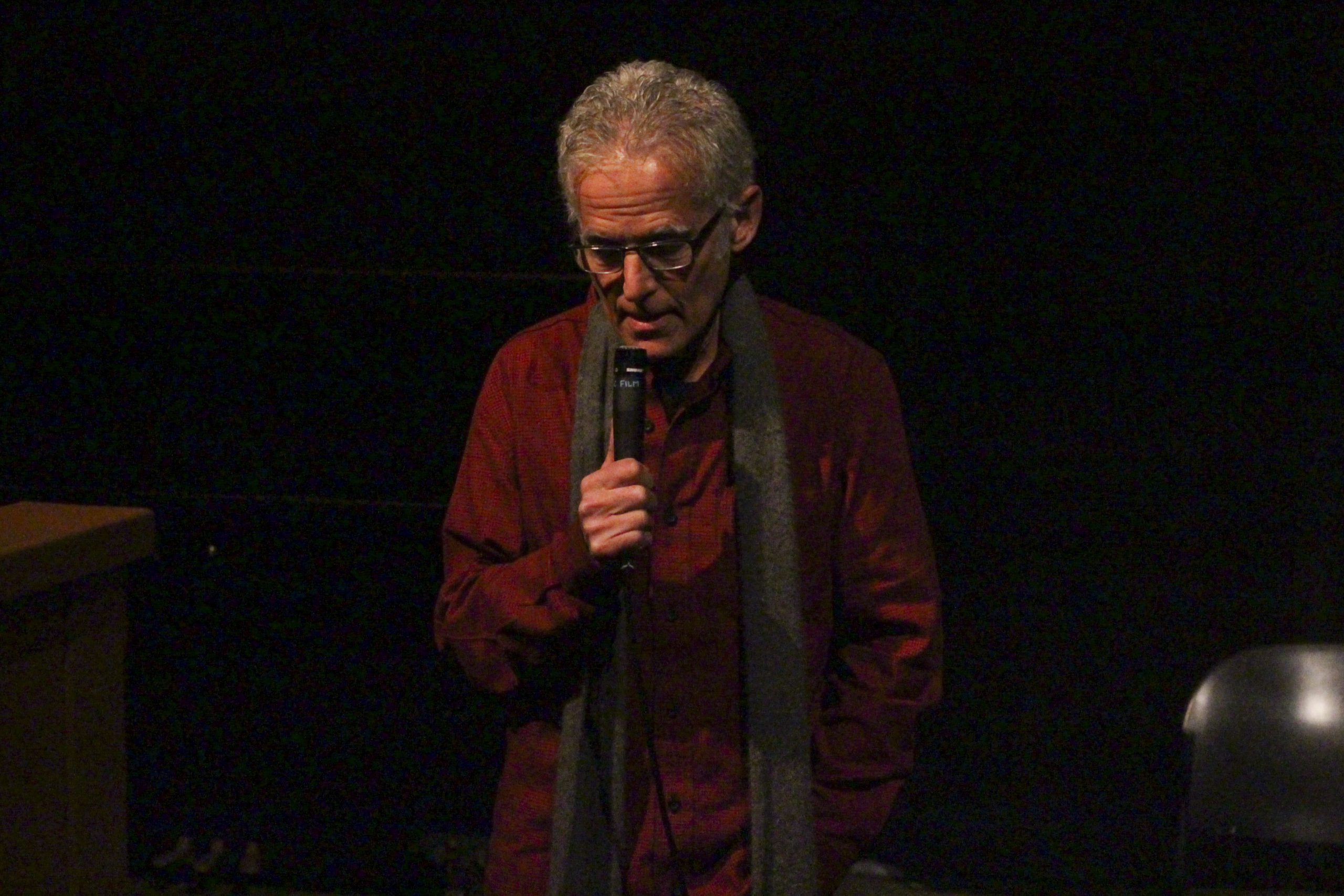
Award-winning filmmaker Jay Rosenblatt paid a special visit to the Putnam Theater on Thursday, March 30. Following a short introduction by Rosenblatt, attendees viewed three of the filmmakers’ works and one portion of another, with Rosenblatt among the audience during the screening.
The films shown were “I Used to Be a Filmmaker,” “When We Were Bullies,” “How Do You Measure a Year?” and an except of “Human Remains.” The middle two films each earned Rosenblatt an Oscar nomination, while the latter film had earned him a Sundance Jury Award.
According to his website, Rosenblatt primarily works in the area of ‘collage film,’ a type of filmmaking which utilizes archival footage to tell a story.
Rosenblatt’s film “Human Remains” uses archival footage of authoritarian leaders, such as Adolf Hitler and Benito Mussolini, with accompanied narration of voice actors of both their native language and English overlaid.
“‘Human Remains’ is a haunting documentary that illustrates the banality of evil by creating intimate portraits of five of this century’s most reviled dictators,” Rosenblatt’s website states.
The Holocaust and Genocide Studies (HGS) Department was among three departments to co-sponor the event, along funding from the Global Education and Citizenship Speakers grant. Chair of the Modern Languages and Cultures department Lisa DiGiovanni said the event had been in the works since the beginning of fall.
“We were, at first, kind of worried that he wouldn’t be able to come because… even though we got all this support, because he was nominated for an Oscar… we thought he might not be able to come because of his different engagements,” DiGiovanni said. “He told me about numerous events that he turned down, pretty big events, international events that he turned down but he came to Keene State College which I think is pretty amazing,” she said.
DiGiovanni, who is also an HGS professor, said that the department’s co-sponsorship of the event relates to his work on “Human Remains,” as well as “King of the Jews.” “[King of the Jews] is a personal reflection, Jay Rosenblatt is Jewish, so the film explores antisemitism, and he makes references to his own memories of childhood,” DiGiovanni explained. DiGiovanni and Film Professor Ted White co-coordinated the event. White, who attended San Francisco State University as an undergraduate student, said his connection to Rosenblatt is personal.
“I’ve known Jay for a pretty long time… we met in San Francisco, we knew each other from the filmmaking community out there and then I hadn’t been in touch with him for quite a few years but I’d shown his films in my class, and I thought you know, it would be fun to see him and it would be great to have him [at KSC],” White explained. White said being able to have filmmakers come to the college is critical. “Keene is a smaller town so we kind of have to consciously bring in people, and we want them to get to know these people to help demystify the process,” he said.
According to White, in addition to attending the screening, Rosenblatt stopped by a film class and viewed students’ capstone projects as well as delivered feedback. At a Q&A session following the screening, Rosenblatt gave advice to film students in the audience. “The first thing I would say is don’t quit your day job, because I still have a day job,” Rosenblatt said. “Filmmaking is not easy… Only make a film that you feel a lot of passion about, because passion will get you to the end, and sometimes it can take years.”
Rosenblatt’s most recent film “How Do You Measure a Year?” garnered laughter and awe from the audience, as it explores Rosenblatt’s own relationship with his daughter over the years and her maturing. The film is a collection of home videos, in which Rosenblatt films his daughter annually on her birthday while asking a set of questions. “My sense is that everyone could relate to it, we’re all children of parents, and some of us are parents of children,” Rosenblatt said. “It’s kind of amazing in 29 minutes to see someone change, so it’s really like watching time go by,” he explained.
Rosenblatt also touched on how his professional career relates to the personal nature of his work. “I was trained to be a therapist and the reason I wanted to do that was because I wanted to heal people and that motivation stayed with me with filmmaking,” Rosenblatt explained. “Part of that is being vulnerable and honest with myself with an audience.”
Nathan Hope can be contacted at
nhope@kscequinox.com