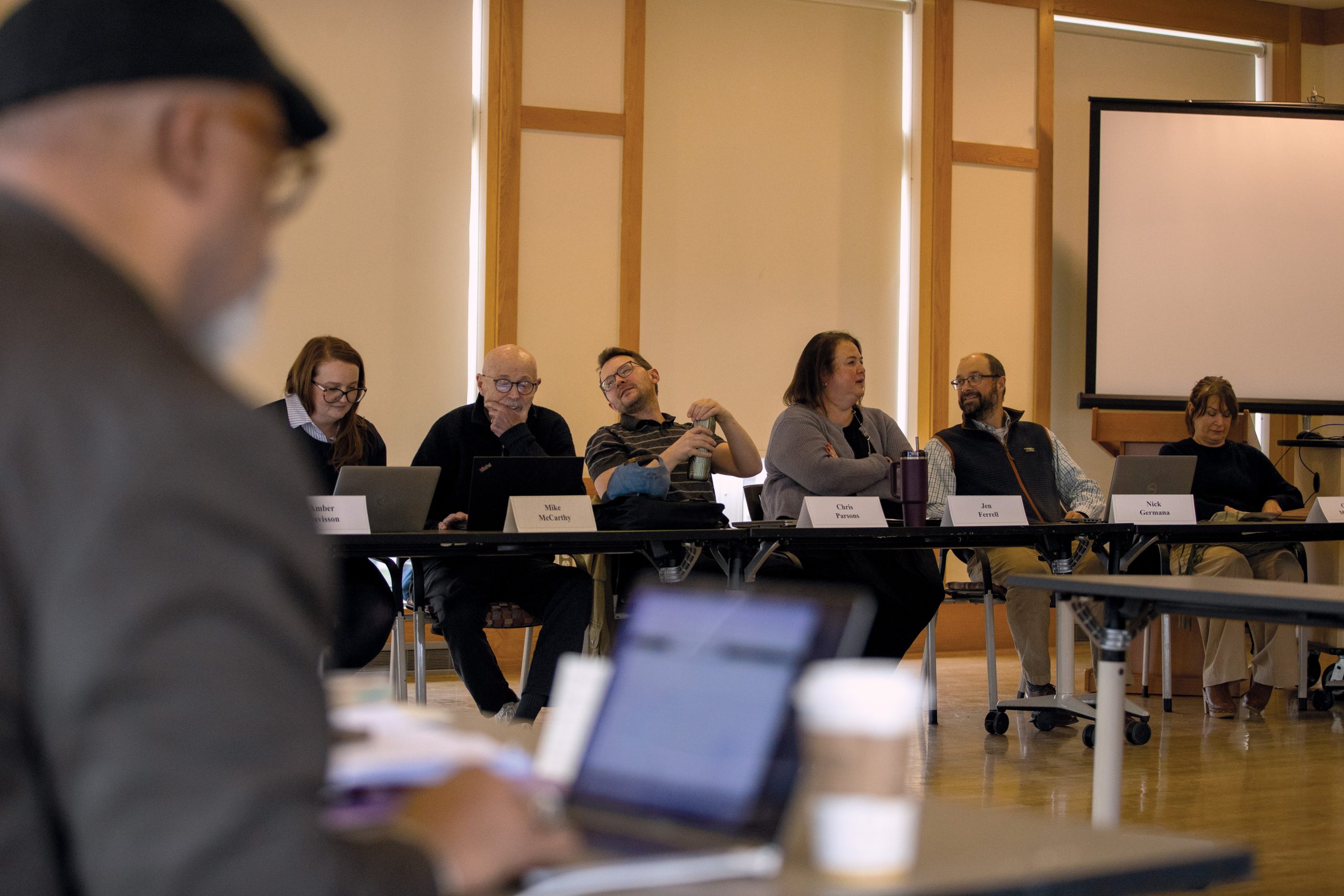


During the 554th meeting of the Keene State College Senate, five motions were put forward by the College-Wide Academic Program Committee (CAP) regarding General Education Exploration (GEE) requirements and the revisions to the Transfer Credit Policy from previous discussions were passed.
Senator and Associate Professor of English and English, Chris Parsons, who was filling in for the chair of CAP, Professor Mike Cullinane, presented the motions for the senate to consider.
“We, at our last meeting, continued our discussion of the gen. ed policies and clarification,” Parsons said. “The first one, we responded to the question, ‘Can experimental policies be used to meet GEE requirements?’”
Parsons presented the first motion that beginning in 27-28, experimental courses cannot be used to meet GEE requirements.
Following the motion being put forward, senators raised questions about the logistics of experimental courses not being available for general education credits.
“We need less regulation; less oversight,” said Randall Hoyt, professor of art and design. “What I’m offering is what I was hired to offer. My best work is not seen by a committee. If I can’t offer an experimental course in gen ed, where can I offer it?”
Greg Knouff, current chair of the Academic Standards and Policy Committee (APS), pointed out some potential concerns.
“Part of the notion of an experimental course is you won’t know it can be a general education course unless you have the chance to experiment with that,” Knouff said. “And I have experience doing that.”
The Senate sent the proposal back to the committee for further discussion, tabling the motion after 15 minutes of debate.
The following motion, which stated that independent studies may not be used to fulfill GEE requirements, was amended to say that independent studies may not be substituted to fulfill a GEE requirement. However, it did not pass.
“We got a similar question about the transfer recommendations,” Knouff said. “We thought long and hard about what should be a policy. I’m not a big fan of creating policy when there doesn’t need to be policy or where it already exists.”
Amber Davisson, professor of communication and philosophy, seconded Knouff’s sentiments.
“This seems like an area where we don’t need a policy since we already have oversight,” said Davisson. “If we have oversight, then I feel like we don’t necessarily need smackdown policy. We have people who are already in charge of the meetings. Just allow the oversight to do its work.”
Parsons presented a third motion, which would have instituted college-wide prerequisites for upper-level general education courses.
“The motion proposes saying that students must complete 30 credits of college coursework, not confined to GEE or KSC courses, including both foundations courses, one each in college writing and QL (Quantitative Literacy), before being eligible to enroll in upper-level GEE courses,” Parsons said. “The 30 does not include credits that are already in progress at the time of the registration.”
Nick Germana, chair of the Senate Curriculum Committee (SCC), pointed out the role that different departments should have in making decisions regarding courses.
“I personally think that we should not have this kind of requirement for the general education program,” Germana said. “But we should allow departments to decide for themselves if they want individual classes. If they want prerequisites. I’d instead give departments the flexibility to decide on their own.”
The Senate rejected the motion.
A fourth motion, that an upper-level GEE course may not impose any specific course prerequisites, did not pass.
Cynthia McLaughlin, associate professor of theatre and dance, pointed out her concerns about the proposal.
“Now that we have just one upper-level requirement, it does feel that some departments could create a richer requirement for an upper-level course if able to have a prerequisite,” McLaughlin said. “I don’t think I would go against the spirit of it being available to everyone.”
CAP’s last proposal, that a GEE course cannot be restricted to students pursuing specific major or minor programs, passed unanimously after no debate amongst the senators.
Greg Knouff, chair of APS, addressed the revisions to the Transfer Credit Policy that have been discussed at previous senate meetings.
Students who have previously earned a bachelor’s degree will not have to complete the general education requirements, Knouff said.
“They will also be exempt from the Keene State College policy requiring 40 upper-level credits,” he said. “They must have a minimum of 144 credits total with the transfer credits.”
The policy passed unanimously.
After the meeting adjourned, the 555th meeting was held to elect a new Senate Executive Committee for 2026-27. Math professor Karen Stanish will serve as chair, Associate Professor of Journalism, Kim Lauffer, will serve as vice-chair. Davisson and Professor of Health Sciences, Margaret Smith, were elected as members-at-large.
Members of Citizens for Keene State College, an organization based around addressing concerns related to campus, were also present at the meeting.
Paul Vincent, a former professor and chair of Holocaust and Genocide Studies, spoke to the work Citizens for Keene State College is doing to improve the campus.
“Right now, we have the attention of the trustees,” Vincent said. “We have been told there is no other organization like this that exists in the state of New Hampshire. That what we’re doing here in Keene is special. We’re the squeaky wheel that’s getting attention. I think that’s important. It’s important for you to know that.”
Chloe Erno can be contacted at
cerno@kscequinox.com