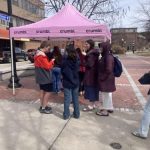







Keene State hosted the Democracy Defense Project (DDP) on April 1, where former Ambassador Dick Swett, former House of Representatives member Charlie Bass and New Hampshire Secretary of State David Scanlan spoke with students about the current political climate.
The DDP is an organization led by former elected officials across several states, New Hampshire included, according to its website. The organization aims to uplift the electoral process, improve voter participation and prevent further polarization and political rhetoric from spreading.
After introducing the DDP and its mission, the representatives opened the floor for questions. Sophomore Jacob Olson asked what they think might happen with the 2028 presidential election.
Secretary Scanlan said, “The variables that have been in play for the last three or four elections have caused high voter turnout, because people felt passionately about the candidates. I think the next election will set another record of voter turnout and participation.”
Swett, a member of the Democratic Party and former representative for N.H.’s second congressional district from 1991 to 1995, said, “My feeling is that we’re going to see a result that we hope is because of the work that Charlie [Bass] and I are doing, and others like us. Getting the public involved, open dialogue and most importantly encouraging people.”
Swett also said students should try volunteering at electoral polling places, as this would teach them about how elections work. He said it is important to not only have people mark names off lists and hand out the ballots themselves, but to check on those running the voting processes to ensure they’re operating in a fair manner.
In addition to being a former N.H. representative, Swett served as the U.S. ambassador to Denmark from 1998 to 2001. He explained that seven of the eight states included in the DDP are battleground states from the 2020 presidential election.
Swett said that many people felt that the “tabulations [of votes in the 2020 election] were not fair or transparent.” Swett said that the reason N.H. was included in the DDP, despite not being a battleground state, was because it has “high levels of confidence in the voting process,” and Scanlan believed in making the conduction of it “well understood” by the public.
Swett added later on that N.H.’s voter turnout was often a greater percentage than the national average. He said this was likely due to the confidence that voters have in how the elections in N.H. are run compared to how people feel in other areas of the country.
Bass, a member of the Republican Party, won the election for representative of N.H.’s second congressional district in 1995. He served as a representative until 2007, and again from 2011 to 2013.
Bass said that a tradition in N.H. under Scanlan and his predecessor, Bill Gardner, was local control and training in the voting process. He said that the state’s system is “very transparent. It happens right in front of you, and that makes a difference.”
Swett said that both he and Bass believe the issue of polarization needs to be addressed. “When we go into certain crowds, typically the older political crowd, they take a second look. They don’t think a Republican and Democrat can sit in the same room together,” said Swett. “This is what is defining our country. This is what needs to be fixed, and we’re here to help you figure out how to fix it because it’ll be you folks doing that.”
“We’re here because we feel that if America is going to survive, it needs to maintain free, fair and transparent elections,” Bass added.
Bass also said that the Republican party has always supported smaller, local control, but he feels that the current administration wants to “federalize everything that he [President Trump] doesn’t agree with.”
Sophomore Samuel Jensen brought up how statistics show that the everyday person is more neutral than extreme in their political beliefs, despite what the media and politicians say. Jensen asked the representatives if they had seen more polarization amongst their colleagues or in those outside of politics.
Swett said one of the reasons he ran for Congress was that he began to see polarization taking place and vowed that he would never introduce legislation without a cosponsor from an opposing party.
Swett added that primary elections often drive people to extremes and make it almost impossible to get back to a moderate center. He said that the parties are often the ones forcing these types of elections.
“These are the challenges we’re up against. To counter that, Charlie [Bass] and I believe we need to get out and talk to people,” said Swett. “We need to tell them that we’ve got to get back to the center where solutions reside or it’s going to be a real pox on our nation.”
Bass said he believes the country is more regionally polarized than in the past, but it is necessary to discuss the ability to tolerate. “Tolerate those with different views than yourself,” he said. “We got along pretty well in Congress across the aisle, but it’s different now.”
“As long as the people in this country believe that the process of succession is fair and transparent, we will survive this. If we lose that and have polarization, then that’s a real problem,” Bass said.
In regard to the SAVE Act and House Bill 323, a proposed bill that would prevent students from using their college-issued ID cards as valid forms of identification when trying to vote, Swett said that the DDP was against the federal government’s involvement in determining what is or isn’t considered proof of citizenship.
He said the DDP “supported the need for proof of citizenship,” but not security measures that would make voting difficult for those who qualify.
Those interested in the Democracy Defense Project and its mission can find more information on the organization’s website.
Samantha Menard can be contacted at