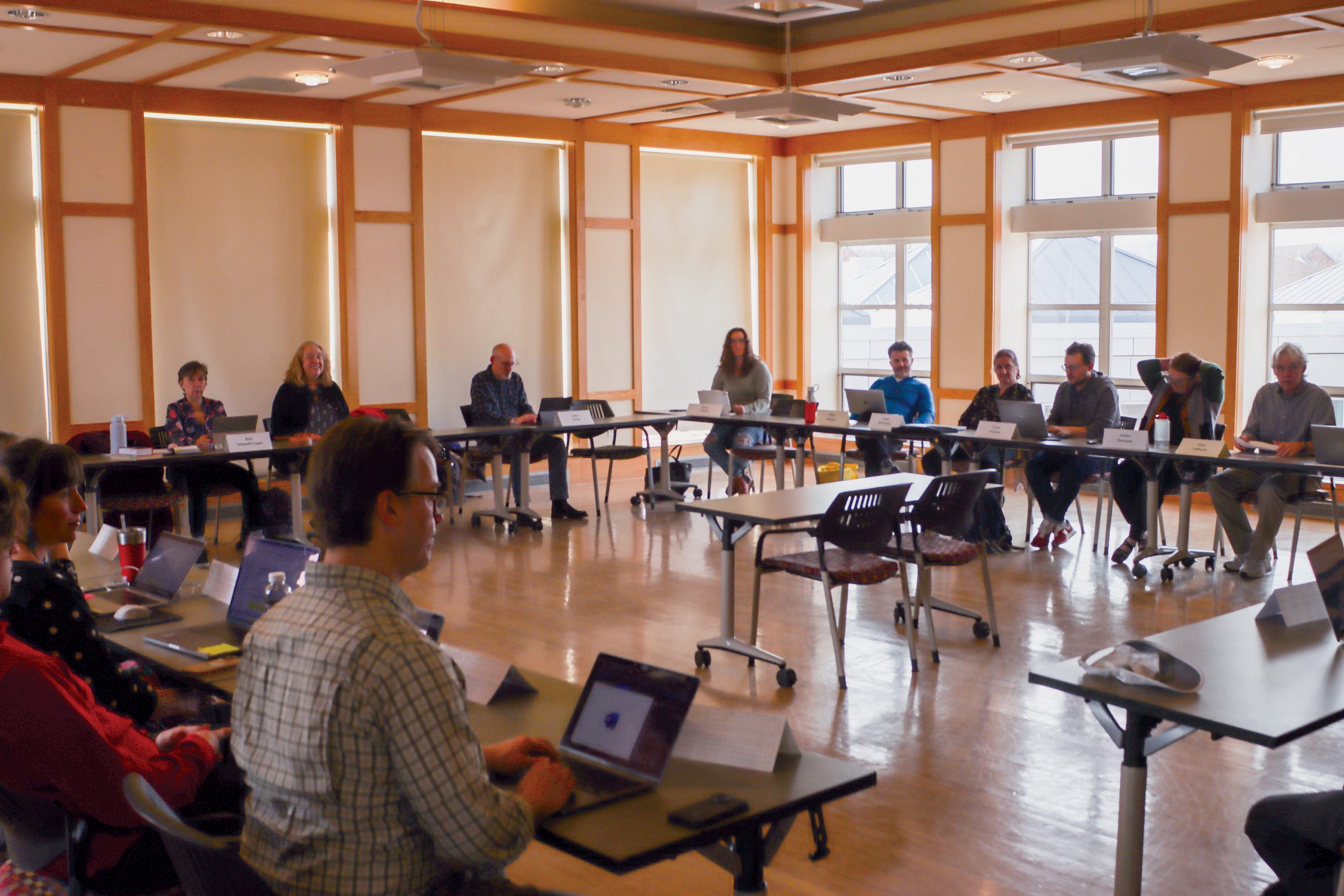
The KSC Senate held a meeting on March 11, where the College-Wide Academic Program Committee (CAP) shared that it continued its work on questions raised by the Senate Executive Committee (SEC) at a previous meeting.
SEC requested that CAP clarify the policy language being used for General Education Explorations (GEE) or develop policy recommendations based on questions regarding GEE’s requirements.
“We will hopefully be reporting back before the end of the semester with some conclusions and recommendations,” Senator and professor of mathematics Mike Cullinane said on behalf of CAP. “One of the questions CAP has been charged with is whether experimental courses can be used to fulfill general education requirements.”
Cullinane explained that some experimental courses offered in the last two years counted toward ISP requirements. However, due to the curriculum pause, there wasn’t an opportunity for the courses to be reviewed as part of the regular curriculum.
Cullinane said CAP was within “a migration of ISP courses into the general education explorations program,” and that they were looking to extend that courtesy to currently existing experimental courses. According to Cullinane, incoming students would be following the ISP for general education, while students already attending KSC would have to continue to fulfill the current requirements.
Cullinane requested that the Senate approve the motion that any existing experimental ISP courses would fulfill GEE’s requirements. The motion was seconded and a discussion ensued, which included a recommendation by a representative from the registrar’s office.
The representative said that they felt experimental courses should have an intent form sent in on their behalf, stating that whoever teaches the course is “intending to potentially create a permanent course out of that course, and they intend for it to be part of the general education curriculum.”
The representative also said that under special circumstances, the intent forms would be reviewed by CAP. If CAP and the course’s department approve the form, then the registrar’s office will build the course into GEE.
Senator and professor of communication and philosophy, Amber Davisson, explained that the courses themselves were already present on schedules and on student self-service, but they weren’t being counted as ISPs. Davisson said that when searched for by students, the courses would not show up under anything but their specific title.
“The request is that those courses be tagged for next year, particularly because in several of these cases these courses have been run multiple times as part of the gen ed curriculum,” Davisson said. “[The motion] simply says that if you have a course that has already been run in the past two years that very likely would have gone through the curriculum, that the course should be tagged as such for next year.”
Davisson said that by the time an intent form was submitted and approved, it would not matter for the upcoming semester, as students would be enrolling for fall 2026 after spring break.
“Students will not have found these courses. They will not be enrolled. We might as well pull them off the books now,” she said.
Davisson also said that while the impact of the motion wouldn’t affect more than a few courses, it would greatly impact the departments featuring them, as they would not get any student enrollment.
Senator and associate professor of journalism, multimedia and public relations, Kimberly Lauffer, asked if the tagging of courses as gen ed could be done by department or if it would classify all upper levels as such.
The representative from the registrar’s office said that if one course was determined to be a general education course, then all experimental courses would be considered part of it as well. “There would be no way to delineate between the two. We generally do things college wide,” they said.
The representative said that the registrar’s office had been finalizing the catalog for student course selection, and they felt the conversation surrounding tagging experimental courses as gen ed should have happened last year.
After further discussion, a suggestion was made to add GE after the few experimental courses looking to be added to the general education curriculum, such as COMM 199-GE.
The original motion, proposed by Cullinane, stated, “CAP moves that the Senate approve permitting currently existing experimental Integrative Studies Program courses to fulfill requirements in General Education Explorations,” and was voted on with six in favor, one opposed and one abstention.
In addition to the motion by CAP, the Academic Policy and Standards Committee (APS) made minor revisions to their Credential Integrity Policy and requested the senate’s approval. No discussion followed the motion, and it was carried with no opposition or extensions.
During the senate meeting’s courtesy period, it was mentioned that the Redfern Art Center will be welcoming a theater company from Chicago at noon on April 1. The company will be putting on a free puppet show for local elementary students and Keene State faculty, staff and students are welcome to attend.
Samantha Menard can be contacted at