
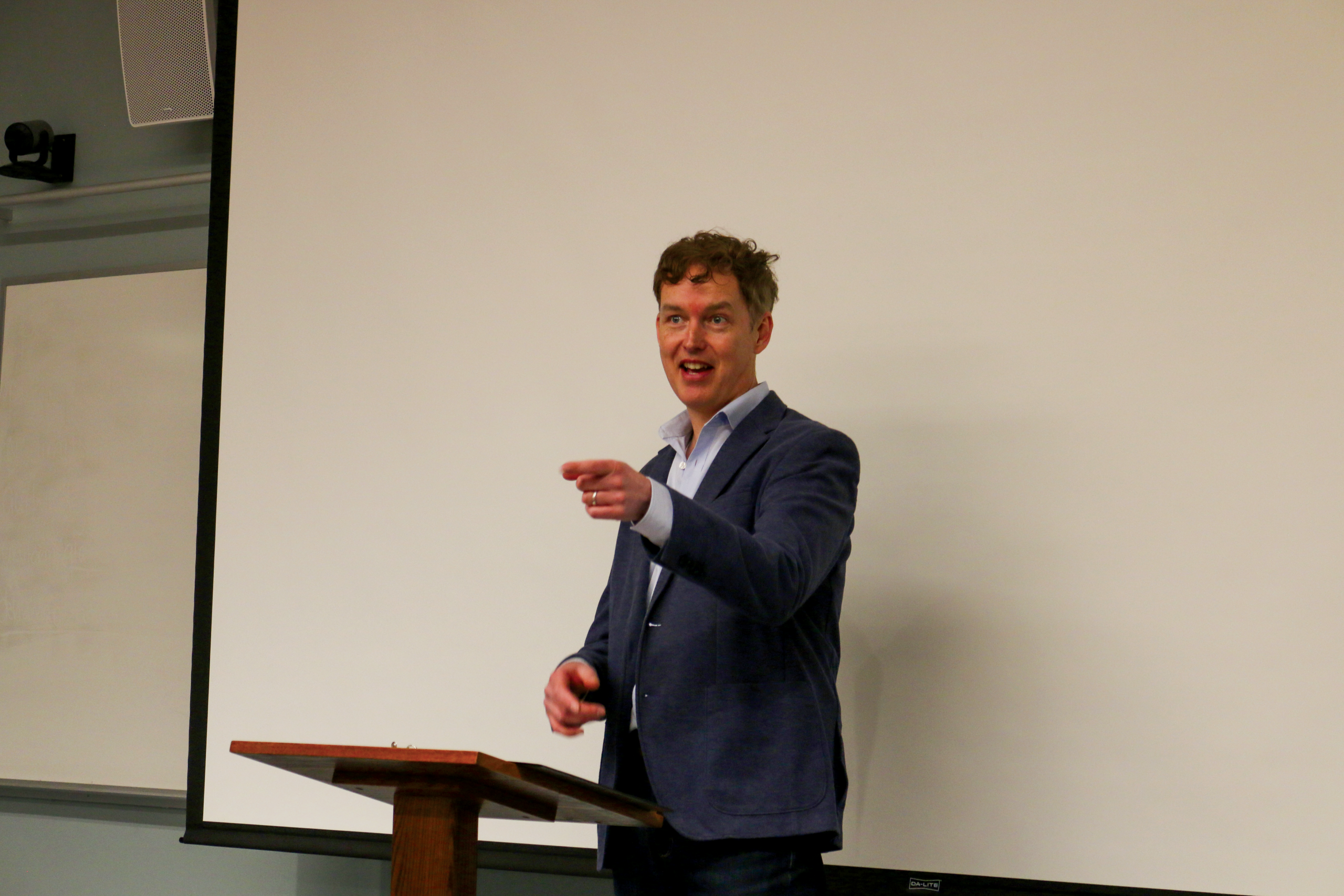
On a rainy Thursday night, 13 Keene State community members gathered in the Mason Library to listen to New Hampshire Film Festival Co-Founder and University of New Hampshire (UNH) alum Dan Hannon deliver a lecture on the importance of public arts.
The event was part of the 2026 Sidore Lecture Series, named after Saul Sidore–a New York-born son of immigrants who was heavily involved in the knitting industry–aiming to enhance faculty efforts to challenge students and the wider community to participate in dialogue, according to Assistant Vice President for Academic Engagement Celia Rabinowitz.
Hannon’s lecture focused on how the arts–specifically film–shaped his personal life, as well as the power of shared experience and connection found through watching movies.
“I remember sitting in an inner tube next to other elementary school friends in their inner tubes as we floated in a town pool with the lights off, watching a screening of Jaws projected on a wall, and as you can imagine, stricken with fear as to what could be lurking under the water beneath our legs and our inner tubes,” Hannon recalled.
Early on in life, Hannon said his first perception of the arts was through his schooling, where he jokingly referred to the time spent making art as “farts and crafts.”
“I remember being in kindergarten, playing G.I. Joe with my buddy at the time, having fun in our serious military operations in G.I. Joe, but then it was time for ‘farts and crafts,’ we deflated,” Hannon recalled. “However, hindsight’s a powerful thing, right?
Now I see all my early exposures to the arts all through my life, from kindergarten on, as very different because it was building inside me and growing my soul into what it is and how I always see things.”
Hannon, who went on to graduate from UNH with a biology degree, also spoke on how the sciences are interwoven with the arts.
“People will remark to me about my biology degree. ‘Oh, so you don’t really use your degree at all, huh?’ No, no and I surprise them when I say that, actually, I do all the time because, you see, my interest in biology came from my interest in fascination, simply with the world around me,” Hannon said.
Hannon expanded on the thought, adding that the first tenet of the scientific method is observation.
“You guys have probably heard of observe, question, research, hypothesize, experiment, analyze, conclude, and then rinse and repeat, right? But guess what else uses the same scientific principles? The arts,” Hannon said.
Hannon also remarked on the importance of in-person connection through the arts.
“We have the opportunity and the choice to engage each other, right, using art in whatever form it is as a catalyst and a conduit to form and strengthen our connections as friends, neighbors, community, humans, really,” Hannon said.
Rabinowitz spoke on the defunding of the public arts by the New Hampshire state government earlier in the event.
“This is an office [NH Department of Natural & Cultural Resources’ Division of the Arts] that had six full-time employees and offered grants to filmmakers and artists and theaters and museums to be able to provide access to the public to all kinds of art and culture,” Rabinowitz said, adding that its workforce was reduced to just one employee after cuts. “We wanted it [the Sidore Lecture] to think about bringing people in to talk a little bit about why, in their experience, this is really enriching and why it’s worth thinking about having our regions and our states support this kind of thing.”
Rabinowitz added the Film Studies Department was the first to respond to her call for lecturer suggestions, ultimately landing on Dan Hannon as its pick for the lecture.
“I’m really thrilled that we have [Hannon] here from the New York Film Festival.
He’s actually been with us all day so [he] arrived and sat in with our senior film students and watched a bunch of work in progress and then hung out and gave an hour-long presentation about film festivals,” said Film Studies Department Chair Jo Dery.
Hannon’s overarching lesson from the lecture was simple: “Go out and engage. Be an example and show why it’s important to you. If it’s important to us, then other people see that.”
Nathan Hope can be contacted at