
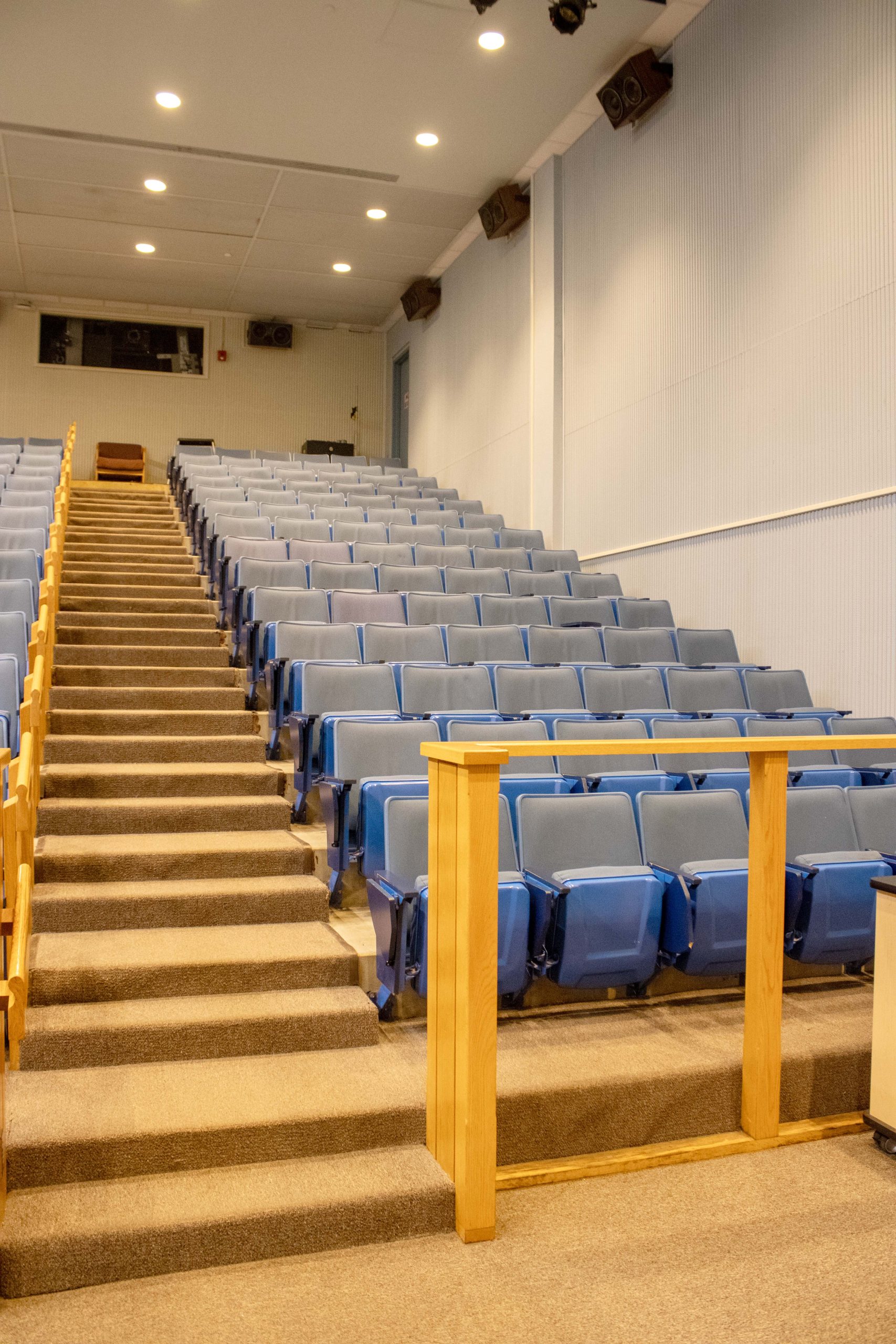
In partnership with the Film Department, the Cohen Institute for Holocaust and Genocide Studies hosted a free viewing of the film “Quo Vadis, Aida?” on Thursday, Feb. 26 at 7 p.m. in the Putnam Theater.
The award-winning film tells the story of Aida, a translator for the UN in the small town of Srebrenica, Bosnia, in July 1995. When the Serbian army takes over the town, Aida’s family is among the thousands of citizens looking for shelter in the UN camp. As an insider to the negotiations, Aida has access to crucial information that she needs to interpret.
Hannah Eliason, the Program Manager for the Cohen Institute, said they chose this particular movie because of its portrayal of the impact of the Bosnian genocide.
“The film captures the tension and tough choices faced by victims, the actions of perpetrators and the limitations of international actors,” Eliason said. “It doesn’t present the story in black and white, but rather it shows genocide as a process shaped by human decisions and political contingencies rather than a static event.”
Eliason said that the Bosnian genocide is especially important to study because of its recency.
“The genocide in Bosnia challenges the idea that genocide belongs to a distant past,” she said. “It occurred in Europe in the 1990s, in full view of international institutions tasked with its prevention.”
Eliason said she thought the screening went well.
“Even though there was no Q&A following the film, many people commented on the way it highlighted different perspectives of victims, perpetrators and international actors,” she said. “It seemed to encourage reflection and conversation, which is what we hoped for.”
“I also hope that people take away that genocide is not inevitable but rather unfolds through decisions,” she added. “The film focuses on how ideology, bureaucracy and inaction can come together, and how systems can keep running even when lives are at risk. It raises a difficult question about responsibility in what might have been different if someone in a position of authority had chosen to act, to refuse or to intervene.”
The screening was part of a larger series discussing the Bosnian genocide. The next events will include a conversation, “Reconciliation Work in Bosnia Today,” on April 2, as well as Bosnian Coffee Hours on March 4 and April 2.
“Cultural events like these are essential because genocide not only destroys lives, but also targets the social and cultural fabric of communities,” Eliason said.
Attendees said that they were heavily impacted by the film.
“It was a very well-made movie,” said senior Lochan Sharma. “I learned a decent bit about the history of the Bosnian genocide.”
“[It was a] very moving film,” said senior Haley Bassett.
Emily Sloane can be contacted at