

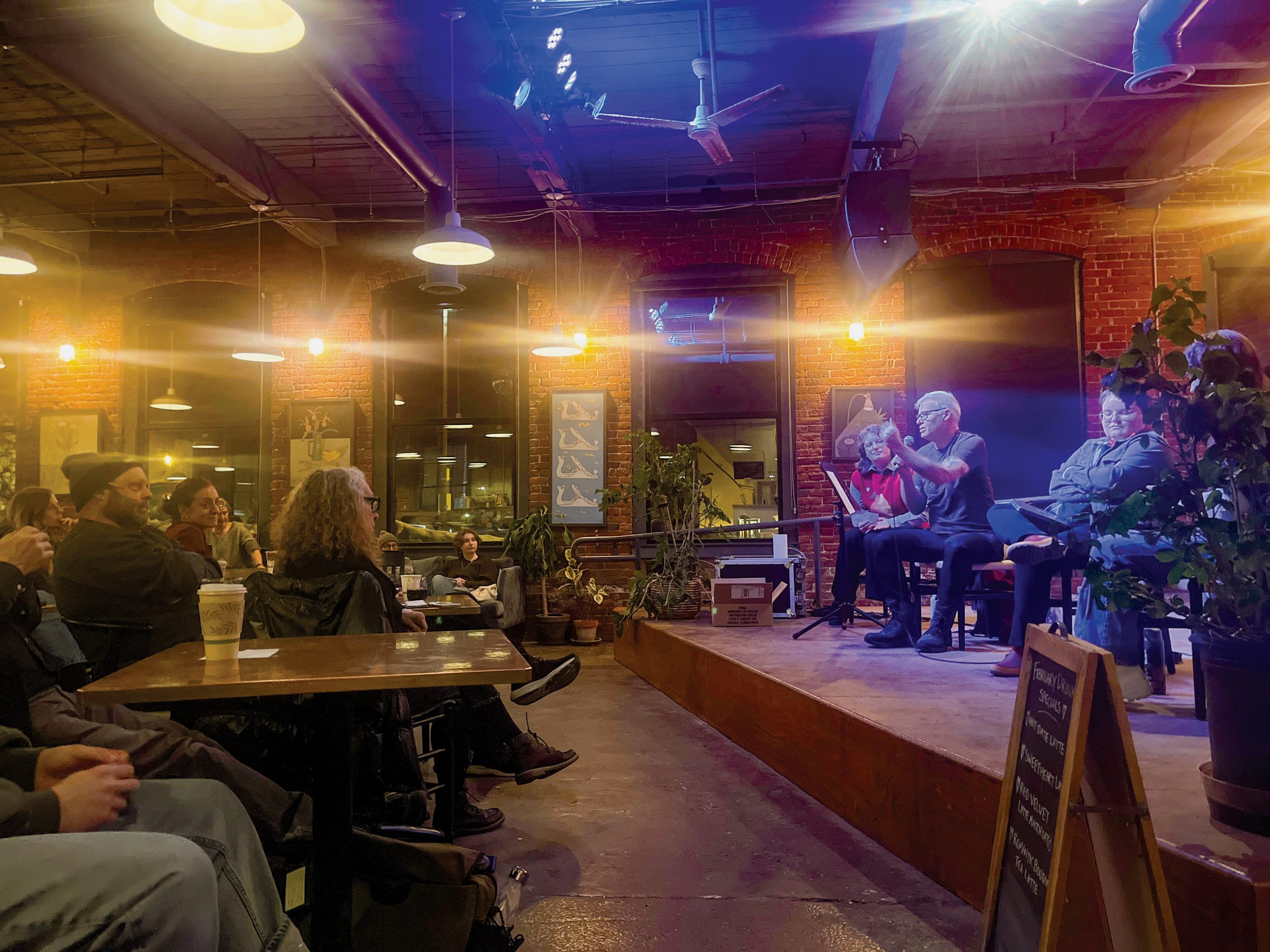
On Feb. 19, Cooperative Action Monadnock (CAM) partnered with Keene-based café Brewbakers to host the first of their “What Can We Do About It Here?” sessions designed to open public conversation about the current conditions of existing under the U.S. government.
Over 100 people gathered in Brewbakers to listen to community panelists, including author of “Replace the State” and former KSC professor Sasha Davis, Antioch University’s PhD of Environmental Studies Program Director Jules Gibson and CAM member Kayli discuss the current political climate and answer questions from the crowd about how the local community can support each other when dealing with organizations such as Immigration and Customs Enforcement (ICE). The meeting ran from 5-7 p.m. and included a warm-up discussion period, panelist speeches, questions from the crowd and closing remarks.
“The theme of tonight is examining why we face an increasingly violent and uncooperative government,” Davis said in his opening statement. He discussed his experience studying oppressed people in places such as Hawai’i and Okinawa and highlighted common tactics utilized by oppressive governments.
“Often governments do not get rid of the constitution altogether, but instead use select instances to invalidate human rights by saying this particular group of people is a threat and the constitution does not apply to them because of this irregular situation,” he said. “They make justifications for the exception.”
“Many governments do this,” Davis continued, “Nazism is obviously the extreme example, but Russia has done this, America has done this and Australia has done this, among others. They say the rights do apply to everyone, but they actually don’t apply to you, you, you and you. And today’s precedence is particularly dangerous as there is a revelling in this right now for many people. They’re taking photo ops, they are celebrating– they have no intention of feeling bad and they are not going to stop.”
Davis went on to discuss the current plans for an ICE detention center to be built in Merrimack, N.H.
“They are planning on making this even bigger. They want 600,000 people detained within the next year. That’s the population of Vermont. And if they didn’t have the intention of filling these beds, then they wouldn’t build them.”
Davis then shifted the discussion to what individuals can do to take stands against the oppression taking place around them.
“Firstly, you need to loudly contest when people are making contentions. Don’t draw lines around labels domestically or overseas. Secondly, we need to gun up the machinery of this project. There needs to be rapid response groups formed, and plainly, the facility in Merrimack must never become operational.”
“Lastly, we need to examine our histories and study why these processes of exceptions and violence keep happening decade to decade. The core of what’s happening did not just appear last January.”
The mic then went to Gibson, who spent much of their allocated time discussing how the military industrial complex allows oppression and dehumanization to thrive.
“The nature of the military industrial complex is a permanent arms industry production chain. It must always be kept and it can never be stopped, and this inspires very low transparency; it makes big tech and the military industrial complex inseparable and it manufactures consent for violence. It allows us to label people as the other. It allows us to make people killable.”
Gibson cited the genocide occurring overseas in Palestine as a prime example by referencing how companies like Palantir have profited from the genocide.
“Palantir has made Palestine the testing ground for surveillance, and this has continued across Democratic and Republican administrations. Palantir has utilized technology to create lists of targets in Gaza and profit from war crimes, apartheid and genocide. Palantir is also the corporate backbone of ICE, and ICE has made it clear that they intend to use and have used surveillance to identify immigration targets and activists, and this same company’s founder has donated massively to ensure Republicans can keep control of the House.”
Gibson made a connection to Davis’s remarks by highlighting the historical dehumanization of Palestinians that has made the genocide possible, and drew connections between police training in the United States and the IDF, as well as the tear gas being used in the genocide in Palestine being U.S.-manufactured and the same product as what is used by ICE on U.S. citizens.
Gibson then went on to detail a recent case of dismissal of speech on these issues made by the Keene government.
“A community member was arrested at a council meeting when the mayor deemed their comments “irrelevant” after two petitions for a ceasefire in Gaza were dismissed by the council. This was when the second submission was being discussed in a subcommittee and an attempt was made to bend the rules to dismiss the petition as it was deemed an issue that was not germane to Keene.”
The mic was then turned over to Kayli, who urged individuals to know their rights when dealing with ICE and understand that censorship is not a new issue.
“If we don’t understand laws and what laws are being broken that protect our rights, we lose an important piece of moving forward and change, which is accountability. If we can’t understand these issues for what they are now then we will never be able to create change in these systems that perpetuate these issues,” Kayli said. “The censorship of the Palestinian genocide, the censorship on children being taken away from their families without due process and without their constitutional rights, these issues did not start yesterday.”
Kayli went on to detail what rights each citizen has when stopped by ICE.
“The 287(g) authority authorizes ICE to delegate state and local law enforcement and gives officers the authority to operate immigration functions under ICE’s oversight. This makes calling the police in certain situations complicated. If ICE comes to your door, you have the legal right to not open it unless they have a permit signed by a judge. Even if they say ‘we have a permit’, if it’s not signed by a judge then they do not have the authority to enter your home.”
“If you are on the street and approached then you have the right to remain silent under the Fifth Amendment,” she continued. “If you are stopped in a vehicle, New Hampshire does have a stop and identify policy meaning that you are required by law to provide your name and identity during routine traffic stops. However, if an agent asks to search your belongings, you have the right to say no. ICE nor the police have the authority to conduct a search without reasonable suspicion. They do not have the right to destroy your property, and you are absolutely allowed to film ICE and the police in public.”
“Entities like this thrive off the unknown and the unclear,” Kayli said. “We must make it clear who these people are and where they are coming from.”
During the question and answer portion of the gathering, an emphasis on the power of social pressure was made by both Davis and Gibson, and Davis highlighted how the ICE facility being built in Merrimack is vulnerable to direct protest, “to the extent that the state government sees it as a political liability.”
Crow Hamburg, a member of the Keene community, shared their reasoning for attending the event.
“I think the first step is to gather so people asking questions about these things is as productive as it can be, cause when people who want to know the answer to the same question are all in one room, then they can all get that answer,” they said. “I also came because I was curious to see different people’s prerogatives. I wanted to know what specific things people wanted and how they can get involved in the practical applications of achieving those things.”
Emily D., another community member, handed out small flyers detailing information on people’s rights when interacting with ICE and the building of the Merrimack facility during the closing portion of the event. When asked why she attended, she said, “I believe that community and especially having a rewoven community is a bonus no matter what happens and is a strength. I am interested in supporting my neighbors and building community, and systemic change is fractal, so it should trickle from there.”
The panelists emphasized during their closing remarks that this was only the first of multiple discussions that will take place through Cooperative Action Monadnock at Brewbakers in the coming months. The next meeting will take place on March 5 from 5-7 p.m. at Brewbakers and will feature three different panelists involved with the organization. Interested parties can attend the meeting or go to https://cooperativeactionmanadnock.org to learn more information.
Serena Taylor can be contacted at