
Music has and will always have a place in politics.
Often, when a country is experiencing a strong political climate, artists turn to music as a way to express their thoughts and feelings. This is not a new concept and has been happening since the era of classical music.
Ethan Hein, an adjunct professor of music at New York University (NYU) provided his insight on music’s political significance in a Universal Production Music article.
“It was once said [by Paul McGarr in his 1991 essay, ‘Mozart: Overture to revolution’] that if you want to understand the revolutionary fervour of the late 1700s, you can see it in Mozart,” says Hein.
He continues to talk about later music that came in the 1900s, “Likewise, if you want to understand the fervour of the late ’60s, you just look at Jimi Hendrix. It’s all kind of encoded in there, just mostly not verbally? With Jimi Hendrix, whatever he’s singing about doesn’t really matter. You just listen to him play the ‘National Anthem’ at Woodstock and you’re like, ‘Oh, yeah, stuff is about to blow up.”
Political messaging in music has been present for centuries now; that is not something I see changing anytime soon with how divided the United States currently is.
If you’ve ever listened to “Happy Xmas (War is Over)” by John Lennon, a former member of The Beatles, then you’ve heard what I would consider one of the most widely known protest songs. It was released in 1971 following Lennon and his wife Yoko Ono’s streak of activism.
“The song was part of an international multimedia campaign launched by the couple in December 1969, at the height of the counterculture movement and protests against America’s involvement in the Vietnam War,” according to Smooth Radio.
“Music was a key tool for America’s Civil Rights Movement that campaigned for an end to racism,” according to Universal Production Music.
Hein goes on to explain a prominent music figure of that time, Bob Dylan.
“I was just watching the Bob Dylan movie [A Complete Unknown], and I’d forgotten what a big deal “Blowin’ in the Wind” was.”
“From the present, it seems kind of vague and wishy-washy, but I was reading about it and the line, ‘How many roads must a man walk down before you can call him a man?’ That was a really big deal for the black civil rights marchers because at the time, black men in the South were mostly called ‘boy,’” said Hein.
Dylan made many songs with heavy political messaging like “Masters of War” in 1963.
“[Masters of War] demonstrates the real nature of war—that the “masters” who initiate and orchestrate the wars are safe in their homes, while normal (and usually young) people are forced to go out to fight and fear for their lives,” according to the song bio on Genius.
It reminds me of recent school walk-outs orchestrated by high school students in several New Hampshire schools.
Lia Eager, a junior at Concord High School, helped organize the walkout to the State House, according to a New Hampshire Public Radio (NHPR) article.
A photo taken by NHPR shows Eager holding a sign that says, “If you won’t act like adults, we will.”
“You might say that I’m young, you might say I’m unlearned / But there’s one thing I know, though I’m younger than you / That even Jesus would never forgive what you do” is verse six in “Masters of War.”
That messaging in Dylan’s song is being reflected by students protesting across the country right now.
In my elementary school days, I remember singing “We Are the World” by U.S.A for Africa in choir. As a child, I did not yet understand the significance of the song, only that it was bringing people together.
It was written by Michael Jackson and Lionel Richie and the song went on to win a Grammy Award for Record of the Year.
“On March 7, 1985, the world first heard ‘We Are the World,’ featuring a choir of 46 of the biggest names in music across other genres, all united to sing one song to help support those suffering from poverty and hunger in Africa,” said Tina Benitez-Eves from American Songwriter.
Richie was asked if he would write another song like “We Are the World,” but said, “You don’t need any new words.”
“What we were trying to say back then was ‘let’s take care of our brothers and sisters over there because one day it might just happen over here,” said Richie.
“There comes a time / When we heed a certain call / When the world must come together as one / There are people dying / Oh, and it’s time to lend a hand to life / The greatest gift of all.”
These are the first lyrics sung in “We Are the World,” and they still apply today in 2026. As Richie said in the 2022 American Songwriter article, we don’t need any new words.
When our neighbors are being kidnapped and killed by Immigration Customs and Enforcement (ICE), and our friends across the globe are experiencing genocide like never before, now is the time when we ‘heed a certain call’, and the world MUST come together as one.
Earlier this month, Puerto Rican artist Benito Antonio Martínez Ocasio or Bad Bunny, took on the Super Bowl halftime show and received a lot of backlash from conservative Americans.
Both Bad Bunny and Green Day, the Super Bowl opener, have publicly criticized President Trump in the past. And Trump made sure to express his distaste for the musicians being chosen to perform at one of the most-watched sporting events in the world.
“I’m anti-them. I think it’s a terrible choice. All it does is sow hatred. Terrible,” Trump said, according to an article by the New York Post.
However, the halftime show was anything but hateful. Bad Bunny performed the majority of the show in Spanish, but near the end of his performance, he said, “God Bless America” and proceeded to name all of the countries in North, Central and South America. A parade of those countries’ flags followed Bad Bunny, holding a football that says, “Together, We Are America.”
Behind him was a billboard that read, “The only thing more powerful than hate is love.”
His message focused on uniting all people regardless of where they are from. In my opinion, there was no hatred shown here.
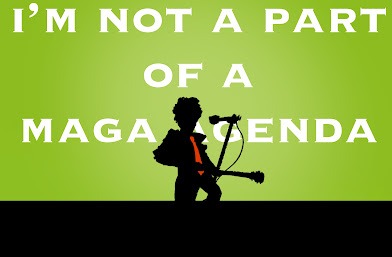
Lead singer Billie Joe Armstrong of Green Day protested Trump with his lyric change at the band’s Jan. 17 concert in Los Angeles.
“He swapped lyrics in protest song “American Idiot” to denounce “the MAGA agenda.” And with “Holiday,” he pledged support “to our brothers and sisters in Minnesota,” according to a Billboard article.
Protestors across the US have even started singing as they gather for protest, in response to lives lost at the hands of ICE agents.
It is still not ‘right against left’ or ‘red vs blue’, it’s the American people united against our growing tyrannical government. The sooner we all realize President Trump has never been “for the American people” as he claimed in his 2024 campaign, the sooner we can make actual positive changes.
No matter what era a song is from, the political messaging is still present today. The role music can play in politics has shown to connect people from different walks of life and backgrounds. That unity will only strengthen us.
Madelyn Marabella can be contacted at
mmarabella@kscequinox.com