

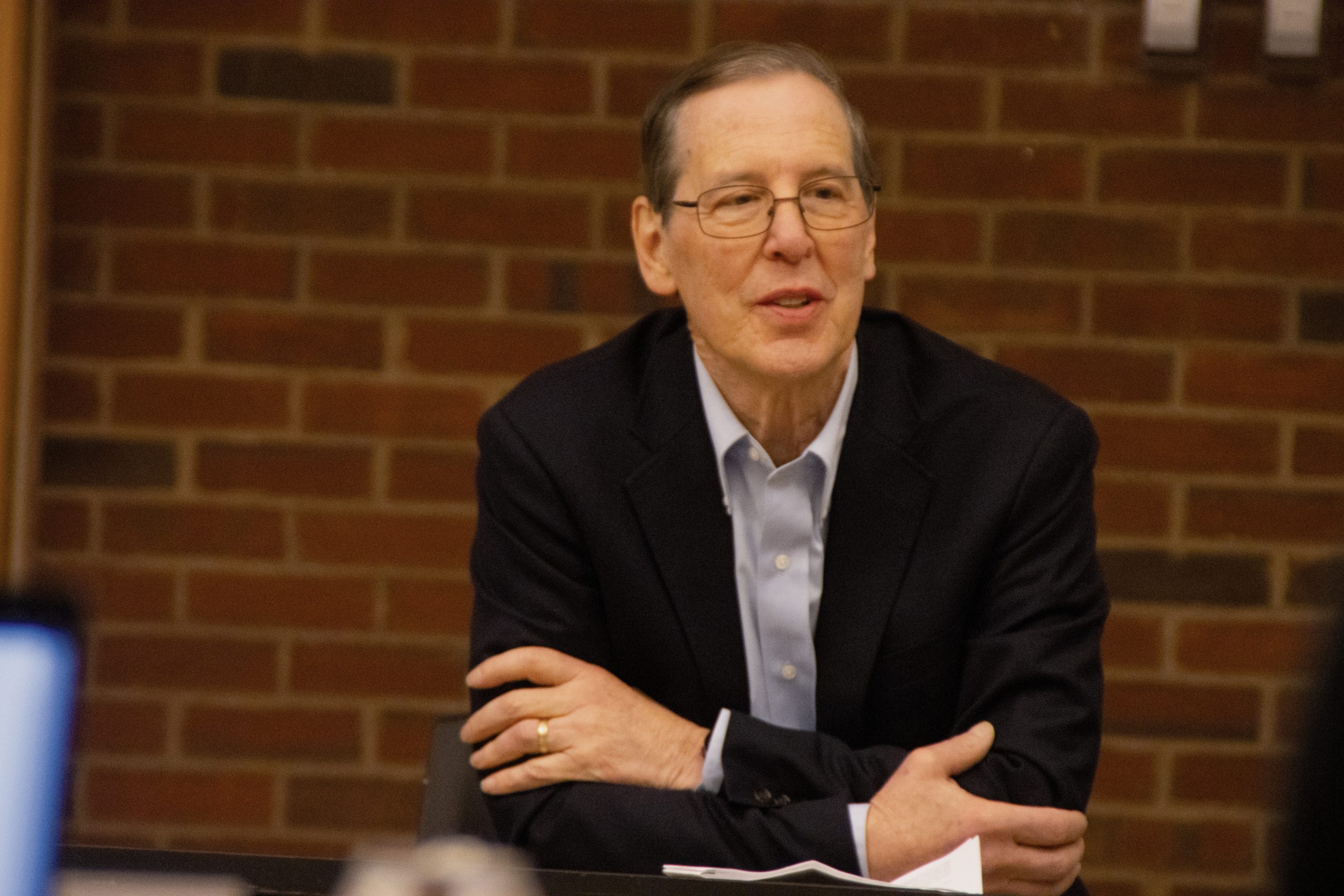
Members of Keene State College’s cabinet, as well as University System of New Hampshire (USNH) Chancellor Cathy Provencher hosted a Town Hall for college faculty and staff to discuss KSC’s future and to answer questions from across campus.
The Town Hall was held on Jan. 23 in the Alumni Recital Hall and featured KSC Interim President Don Birx, Executive Vice President for Finance and Administration Nathalie Houder and Interim Provost and Vice President for Academic Affairs Kirsti Sandy as well as Provencher. The event featured a presentation, followed by a Q&A section, which allowed for audience feedback.
“I think our goal should be to preserve the liberal arts of Keene State College, but do so in the context of the broader picture of liberal arts in the way that liberal arts were constructed years ago, with representation from various [academic] areas,” Birx said.
Birx added that KSC’s liberal arts core, along with its professional and applied programs, has not been sufficiently highlighted in its messaging to prospective students.
He said there would be an advantage to presenting KSC as a three-school model: School of Liberal Arts, School of Applied Sciences and Technology and School of Education and Professional Programs- all featuring different groups and fields of study within them. The schools would be presented to the public in a way that would show how their respective elements integrate and support one another. He said this suggestion could be looked at as KSC still being a liberal arts college, but with three components.
Dr. John Hart, associate professor of music and co-coordinator of music education, shared his concerns over the language used to describe the School of Liberal Arts: “You [Birx] used the word yourself, reinforcers. You pointed at liberal arts and called us reinforcers, implying our job is to reinforce the applied sciences and professional programs. Is that how you view these subjects? Are we, is music just a reinforcer to you? Because I would go toe-to-toe with you any day on that.”
He continued, “And with all due respect to all of the other phenomenal teachers and disciplines here, but music is not any less of a professional or applied program than any other discipline.”
Hart requested Birx and those working on developing the three-school model to refocus and rebrand some aspects.
“As we’re continuing to look at it, please be conscious of the language you’re choosing surrounding this conversation, because it affects the way you think and the actions going forward. This will have a major impact on how people perceive us,” he said.
Birx responded, “There’s a cross-cutting here, there’s strength in the intersections of these disciplines. I do think we have to understand the elements and how the different parts can help each other.” He continued, “I think the liberal arts play a key role in some of the applied disciplines, because the best thing about those disciplines is that we have the liberal arts. They create a totally different perspective on our programs.”
A few audience members, Hart included, said “Music is an applied discipline” in response to Birx’s statement.
Birx added the meeting was meant to begin a conversation on campus, and faculty and staff input would be valuable in what USNH does going forward.
Another audience member praised those in the marketing department for their innovation and hard work, and shared that the department had recently been decimated. “For this [the three school model] to succeed, you have to support the staff that does this work every single day in and out,” she said.
Provencher, who has worked with USNH since 2014, said she had a “soft spot in her heart for Keene State College” due to her previous role as interim CFO under former KSC President Anne Huot.
Provencher said having a financially sustainable school is key, adding that USNH wants to ensure that the system’s revenues will cover the costs to maintain, thrive and deliver on promises made to students at the schools within it.
Provencher also said that some issues were not specific to KSC, and they were generally New England-based.
“We know the number of high school graduates in New England has declined and will continue to do so. We also know that fewer are choosing to go to college, because you can turn on the news and see society starting to question the value of higher education,” Provencher said. “I don’t have to tell you about the headwinds at federal and state levels, which is making our [USNH’s] job even more difficult,” Provencher said.
Provencher explained that over the past 10 years, enrollment at KSC has dropped more than a third, with this past academic year’s fall semester being seven percent lower than the previous year. Despite this, the school has “done a remarkable job with student retention.”
Additionally, over those ten years, KSC has sustained a cumulative $35 million in losses, the result being unrestricted reserves referred to as “pretty much gone” by Provencher. Provencher said this was not because of a lack of state support; however, she added the recent reduction of state support was limiting USNH’s abilities as it tried to make changes that were in the best interest of students.
“We can’t bend the curve on demographics. Maybe we can bend it a little bit for students choosing to go to college, but market share is where we can really bend the curve,” she said.
Ultimately, the solution was incumbent on both USNH and those in the audience, according to Provencher.
“I worry that if the word on the street is, ‘Oh, we can’t solve this,’ that’s going to have an impact on our students, on prospective students. We are in the height of an enrollment cycle. We can solve this by working together,” Provencher said.
Houder said in the past year, departments across campus focused on reducing expenses whenever possible without impacting the student experience.
She added KSC’s academic teams were ensuring the ability to have programs that would attract students, while the school’s admissions teams were out communicating and meeting with them. Additionally, financial aid has been working closely with families to offer support for affordable education.
On the side of expenses, Houder said the difficult decision was made to reduce them through staff and faculty reductions as a result of a drop in state funding seen in the current fiscal year.
The amount that KSC relies on tuition and fees is higher than its competitors throughout the nation, according to Houder.
“Even without the cuts in state funding, we still need to increase revenues or decrease expenses as our costs were increasing higher than revenue. We need to find other sources [of revenue],” she said.
During the Q&A segment, an audience member spoke on behalf of the Child Development Center (CDC) and said the CDC was community-minded. She said the congressionally directed spending of $1 million went directly to their community to address workforce issues in childcare and early education.
“It takes a lot of money and people, but we’ve developed a complete career pathway for educators at CDC to move up and develop professionally. Keene State has been instrumental in this work, and I don’t want anybody seeing that as not being a contribution that the school is making to our community,” the attendee said.
Birx said the issue with the CDC wasn’t related to its work; it was at the state and national level, because they’re not putting funding into early childhood education, which “will have us paying the price later”. He said he thought the work being done at CDC was admirable, and while they want to keep childcare on campus, they may change how it looks.
Houder said the other sources of revenue that the school needs could come from donors, but most of those donations are endowments, which are unable to be used in the current academic year.
Houder said, regardless, the biggest challenge is still KSC’s market share, and that everybody on campus is responsible for bringing students to the community and hitting the 80 percent mark of ensuring those individuals graduate.
Sandy said a difference between KSC students and those at other schools was that they wanted to make a difference in the world. Sandy said that students she had worked with had expressed a desire to help and advocate for people, and that while she wanted that trait to be preserved, she also knew that students in today’s age had to be practical, alongside having an idealistic mindset.
“Our biggest competitor, like Cathy [Provencher] said, is no college at all,” Sandy said.
While more cuts may have to be made in the future, according to Sandy, KSC has to be extremely strategic about them, and they cannot cut their way to financial stability. She said it’s necessary for the KSC community to unite behind a shared goal of lifting up the school so students are able to see the potential of the institution.
Birx said, “We have to be proud of all the pieces that we’ve got, and put them together in a way that people can understand. Nothing is wrong with the mission, but people don’t get past that. They don’t see what’s embedded in the mission, and what makes it a possibility.”
Donna Paley, professor of Sustainable Product Design, expressed concern regarding suggestions made by Birx and the other speakers.
“We have been on the outside the entire time. These professional programs have been treated as if we’re reinforcers. And so, the message that I see today, what I heard for the last hour and a half, is not any different,” Paley said. “It has been an uphill battle to try and get those programs that have been financially supporting the college understood. And the message … I’ve heard the words liberal arts today more than any other word.”
Paley ended by questioning the messaging presented at the Town Hall.
“I advocate for people, and we aren’t ready to collaborate. I don’t believe that’s true. I don’t believe the faculty, which I’m a part of, is ready to have a real message shift. But I want people to think about the finances, the realities in our demographics, and how a big message shift is going to make an impact in the market that you’re talking about,” she said.
Samantha Menard can be contacted at