

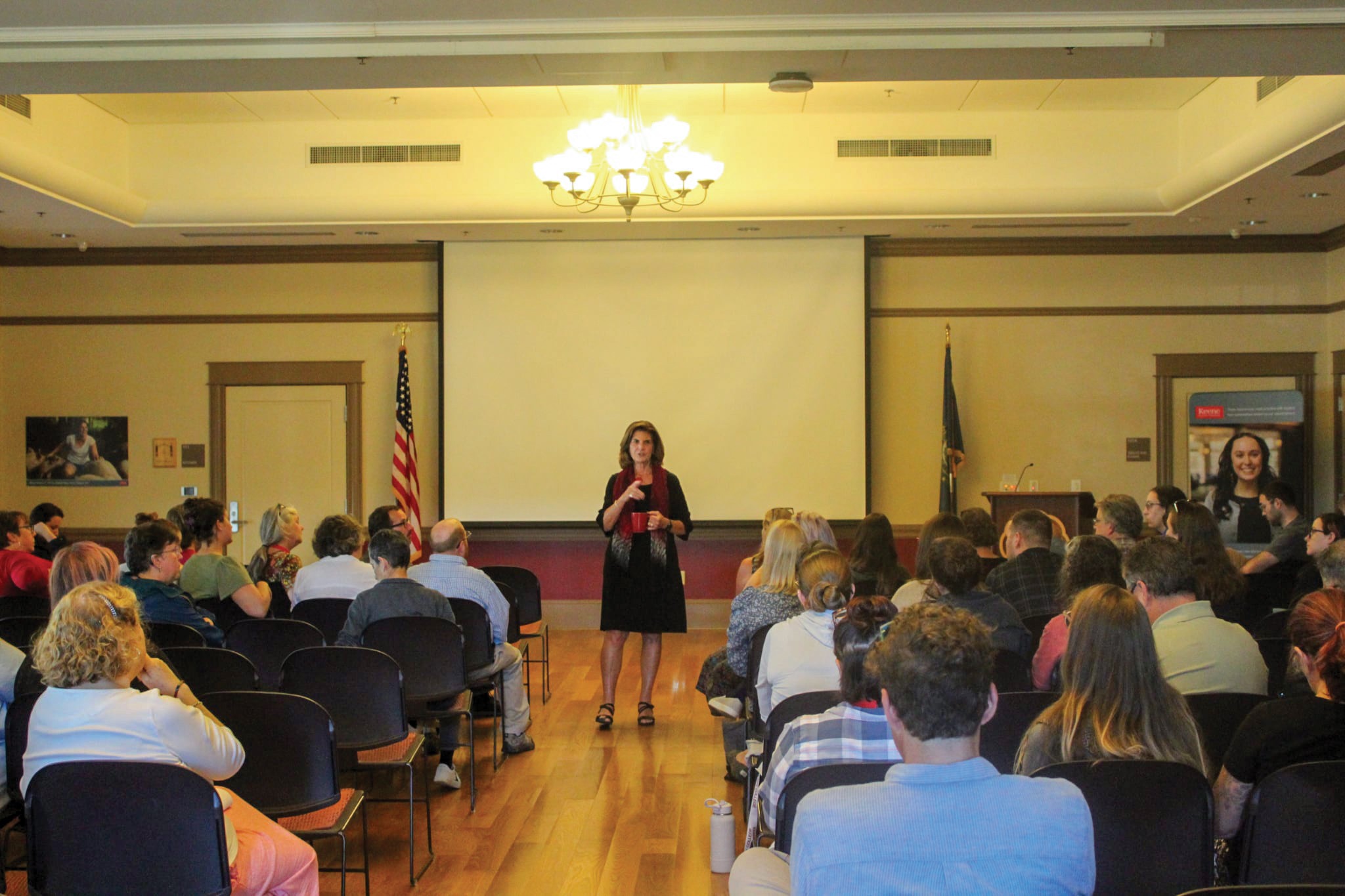
University System of New Hampshire (USNH) Chancellor Cathy Provencher held back-to-back listening sessions with KSC staff and faculty to discuss concerns and ideas regarding a variety of topics related to the college’s future on Monday, Oct. 6 in the Alumni Center’s Norma Walker Hall. KSC staff members attended the first meeting, which was immediately followed by a second meeting with faculty members. The meetings were arranged ahead of the upcoming USNH Board of Trustees board meeting, which will take place on Friday, Oct. 24. The interim structure was approved last week at a meeting in Concord.
Staff Meeting
During the staff meeting, KSC staff members raised concerns about the feasibility of proposed cost-cutting measures meant to offset financial challenges facing Keene State College, as well as the larger USNH system.
Cumulative damages totalling $35 million have been suffered by the college over the last ten years, despite a shrinking deficit. Recent state funding cuts to USNH have exacerbated financial turmoil, with a 15 percent cut leveraged across the entire system in late June, according to previous reporting by The Equinox.
Cost-saving proposals included a shift towards an increase in shared services, where certain operational functions that are traditionally managed by the college would be handled by a single, USNH-wide office shared between colleges. The increase, which would be facilitated through Service Level Agreements, has been floated as a means to reduce spending. Staff members raised concerns about a further pivot toward shared services, citing logistical concerns.
Access Services Manager for the Mason Library Jeff Kazin raised a concern at the meeting about how shared services could be better implemented.
“It looks like most of the models that we have seen involve shared services being centralized much more within [The University of New Hampshire], and I think our experience at Keene State has been that it hasn’t really gone well,” said Kazin.
“I had asked about some of what [KSC President Melinda Treadwell] had suggested we could do to fix that, so that we could do the centralization and still get the services we need here at Keene State,” added Kazin.
One staff member said that cost-cutting measures have already taken too drastic of a toll on Keene State College, and was followed with a round of applause from colleagues at the meeting.
“I think the point that we may be trying to get at is that over the past few years, we have done a lot of work. I know that there has been a description of cutting to the bone, but the truth is we’re into the marrow now. We have areas of campus and departments that are one person deep. If that person leaves, we are going to be devastated, and I think that’s the concern you [Chancellor Provencher] are hearing right now,” said the staff member.
Senior Associate Director of Admissions Bert Poirier said that he was not impressed with the tone of the meeting, and cited concerns about consolidating services at a time when USNH resources are being added. During the meeting, Provencher challenged Poirier’s assessment of increases at the system level.
“There is definitely a movement to consolidate a lot of our services and I get that. The issue I brought up, which was challenged, was that as we take away from people here who help to make us efficient and effective, we seem to be adding at the system level. There’s a certain disconnect there. I was concerned about the amount of people the system level employs now,” said Poirier.
Poirier was also disappointed by a comment made by Provencher during the meeting, when Provencher responded to questions about fostering positive messages about the state of the college to students following President Treadwell’s resignation.
“Is this college one person? Is the college the president?” said Provencher.
Poirier said he didn’t appreciate the comment at a time when the college is mourning Treadwell’s upcoming departure.
“This is a campus that is in mourning. We’re losing the heart and soul of our institution, and being told that [President Treadwell] is not Keene State College opened up some wounds in the room,” said Poirier.
Despite the tensions within the exchange, Provencher praised Treadwell at many points throughout the meeting.
Issues and concerns surrounding the future of the college were discussed, including the possibility of a system-wide transition that would include Keene State College, Plymouth State University (PSU) and the University of New Hampshire (UNH) consolidating into one institution across three campuses.
According to Provencher, USNH is focused on implementing shared services across administrative functions, while maintaining three separate and distinct colleges.
“[USNH] is committed to doing what we need to do to ensure financially sustainable, separately accredited institutions at Keene, Plymouth and UNH. We will do innovative things, and ensure as core to the mission that what we do is executed as effectively and efficiently as possible,” said Provencher.
“That is our mission, and that could mean either reducing spending or increasing revenue,” added Provencher.
At the meeting, Provencher stated that despite partnerships between the USNH and the Community College System of New Hampshire (CCSNH), a model that would include combining the two systems is not likely.
“The free [community] college system wants nothing to do with the university system right now. We are partnering on many different levels, but a combination of the two systems is not a reality at this moment,” said Provencher.
Despite financial struggles, Provencher said that raising tuition would not be a sustainable solution within the current market.
The USNH Board of Trustees approved a 2.5 percent tuition increase in October of last year, despite colleges across New England raising tuition higher. According to Provencher, higher education institutions in general are competing for a smaller population of college students due to regional and national trends in declining birthrates.
“We can’t reduce tuition and sustain, but we also can’t raise tuition to a point where nobody can afford to come. Students have so many choices, and we don’t want to raise tuition to the point where students will choose to go elsewhere,” said Provencher.
“Our in-state tuition is already higher than our peers in other states. When there is so much competition in New England, we can’t go out and say we are going to increase tuition by five percent because students may decide not to come or go somewhere else. It is incumbent upon us to try as best as we can to minimize price increases, but that also means making difficult decisions on the cost side,” added Provencher.
Interim Provost and Vice President of Academic Affairs Kirsti Sandy said that meetings like this help to foster greater understanding and collaboration between USNH and the campus community.
“[Provencher’s] visit was done with a very specific purpose, and I really do appreciate her coming down here to talk to some very large groups, which she did a great job with. I appreciate everyone at the meetings who spoke their minds because that is what we need to be able to do,” said Sandy.
Ryan Pacheco can be contacted at
rpacheco@kscequinox.com
This article was updated Friday, Oct. 24 to clarify when the USNH BOT voted to approve the interim structure.