
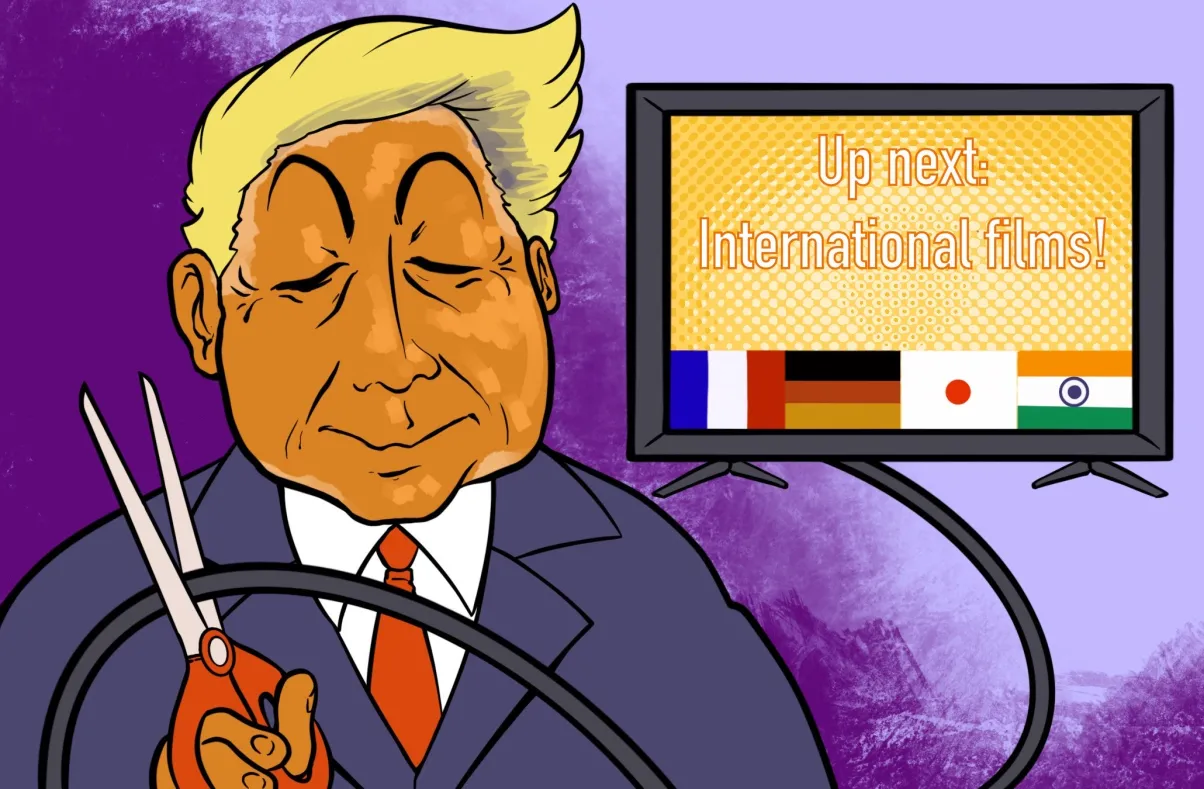
I hope nobody likes movies, considering President Donald Trump is planning to put a 100 percent tariff on all international films, doubling their price and making it just that much harder to enjoy life with things made from anywhere outside of the United States.
The idea was initially suggested by a letter from an alliance of American film unions and guilds back in May in an effort to try and get more movies and TV shows produced in America; however, I can’t help but doubt they asked for such an extreme as a 100 percent tariff increase.
A 100 percent tariff doubles the price of what is being brought into the country, which is going to pass down to consumers. If I had to guess, DVD’s, Blu-Rays, and even movie tickets will boost dramatically in price. Not only will this affect the people trying to enjoy films, but also the American people who work internationally on films with works commonly made in multiple countries.
If this is for all exports of films made outside of the United States, then we can probably say goodbye to most of the movies Americans watched in 2025 because of the fact that it’s a common film practice to carry out elements of a movie (such as producing the film, post-producing the film and adding visual effects) across several countries.
This year, for example, came “Final Destination: Bloodlines,” “Fantastic Four: First Steps” and “Sinners,” but what if I told you two of these hit movies were not produced in America? These aren’t the only 2025 movies that saw success in theatres that were not produced in the United States.
“Mickey 17,” directed by Bong Joon Ho, was produced in England; “A Minecraft Movie,” directed by Jared Hess, was primarily produced in New Zealand and partially in select locations in Canada; “Ne Zha 2,” the highest grossing film worldwide in 2025 (so far) was produced in China, according to IMDB.
Out of IMDB’s top ten highest-grossing films of 2025, nine of them were mainly filmed on locations outside of the United States. The only one I noticed that was fully filmed in American territory was the live action remake of “Lilo and Stitch,” directed by Dean Fleischer Camp, although James Gunn’s “Superman” did have some production in Ohio and Georgia.
American filmmakers rely on other countries for overseas production due to the high percentage of tax incentives some of them have such as Australia, Canada, and England, making it cheaper and more logical to produce films in those places. Also, studios in Asia and Europe can provide better access to financing, distribution networks and access to film markets. The world practically accommodates filmmakers, but here we are, wanting to sacrifice it all because of one person’s opinion.
This isn’t even about numbers; it’s about how Trump is sacrificing the film industry to isolate our country from the rest of the world’s cultures and ideas. According to an article by Reuters, Trump said that other countries are taking away business and profits from American movies like they’re “stealing candy from a baby.” Countries are not stealing from us: they are sharing, because sharing is caring, something Trump seems to have never had to learn in his entire life.
While the movie market is competitive, it’s not competitive. It’s not made for people to just throw movies out to the public to make a profit or jab at other directors. It’s a place where people can tell stories through film, to share messages with the world through an art form that seems to change and revolutionize with every coming year.
That’s why I became a film major, to be collaborative, to tell stories and express creativity and fun to the world. To try and shut out a whole world of these stories simply due to profits and personal preference is why the country is falling apart. This country is for the people, a place of opportunity, a place of free speech and choice, so why are we starting to refuse these basic human rights to those not within our borders? How can someone refuse all outside ideas simply because they are so childish they can’t accept anything different from what they want?
So let’s film where we want to film, since you can’t find every environment you want or need for a film in one country. Either we can see how this tariff will destroy the international movie market system by continuing to make great films wherever we want, or we can compromise the story or quality of a film simply because we are forced to stick within a certain land area to make sure the movie actually makes it to theaters.
Hayley Doda can be contacted at
hayley@kscequinox.com