

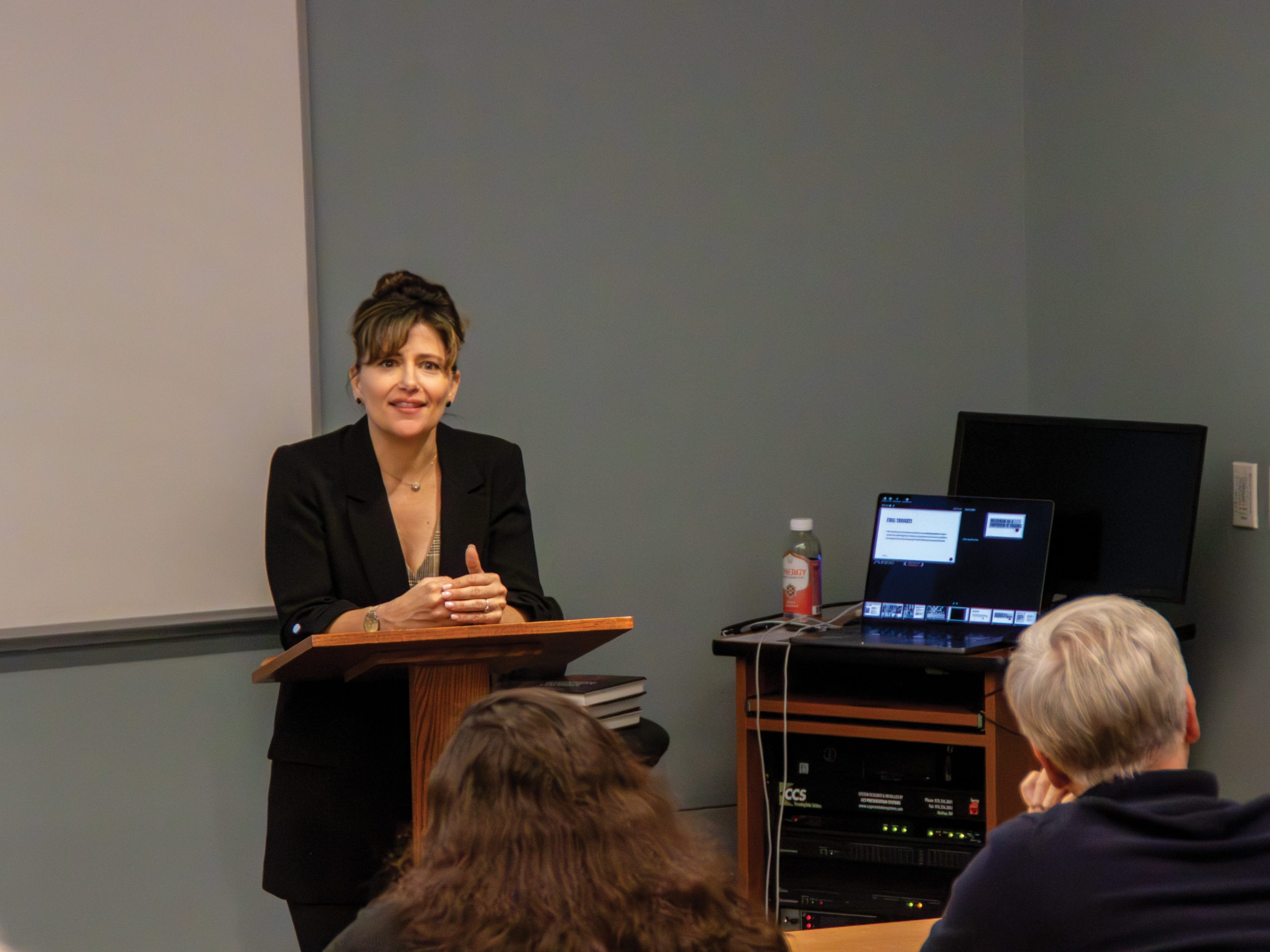

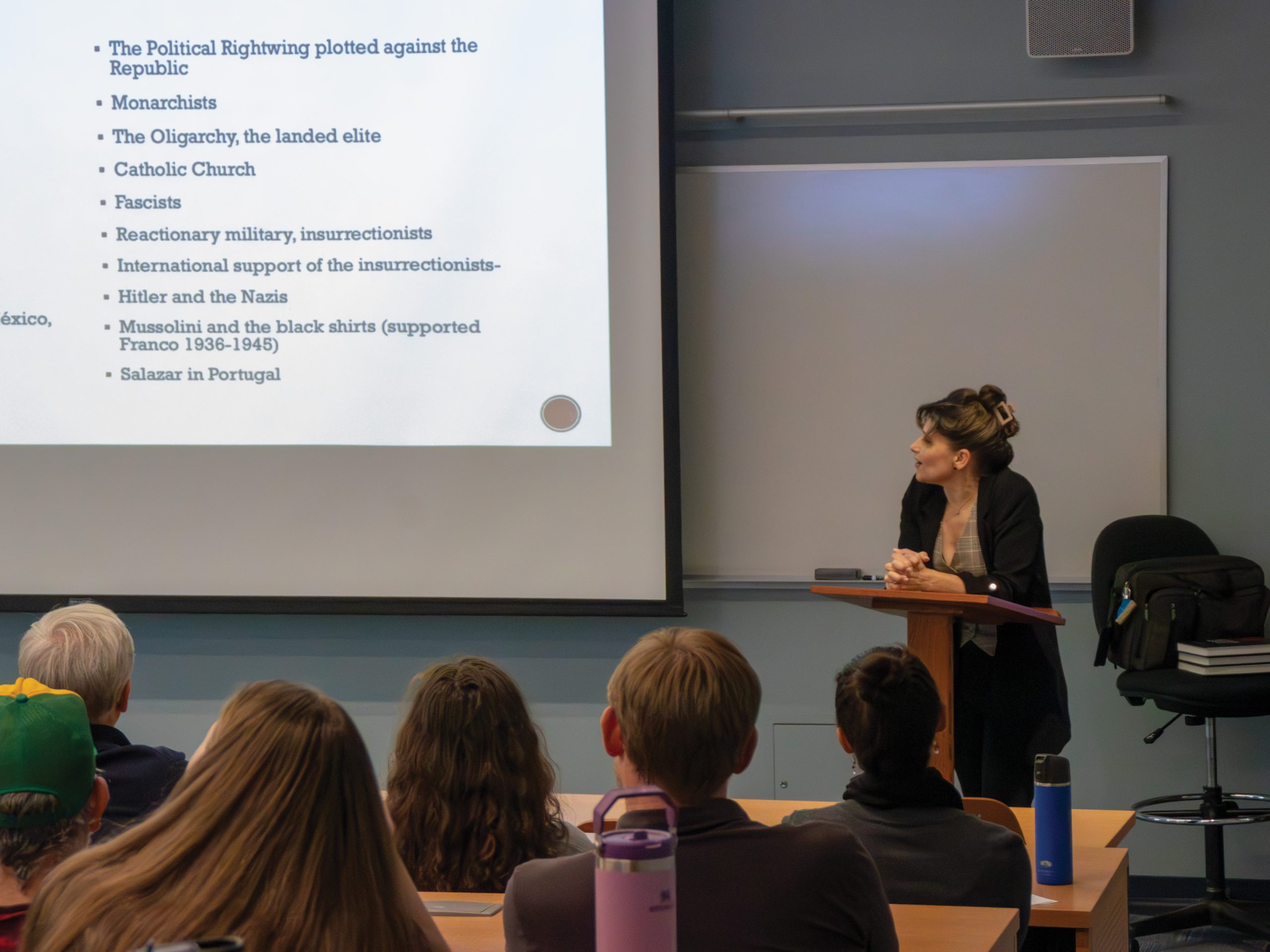

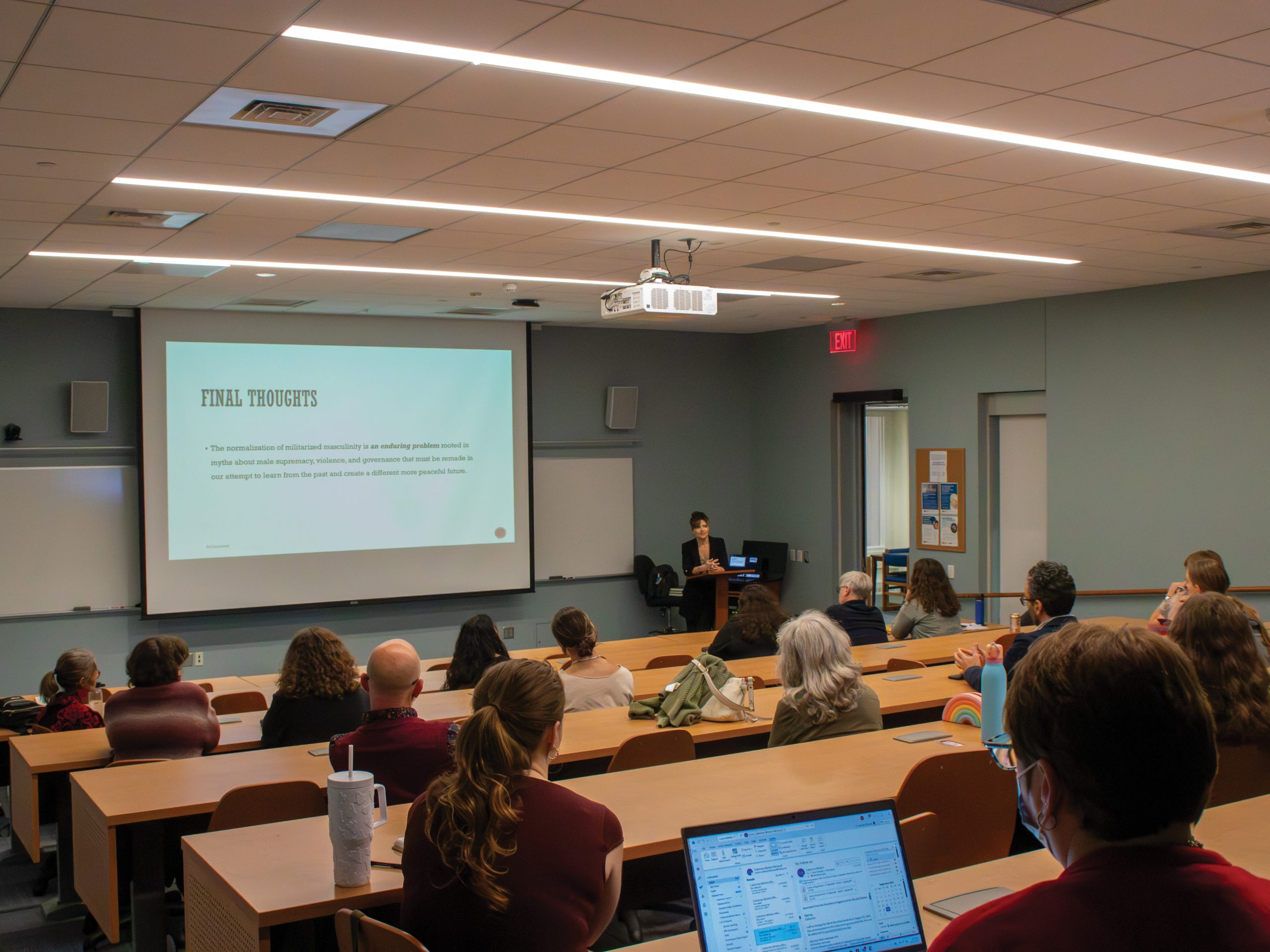


Chair of Modern Language and Cultures and Professor of Holocaust and Genocide Studies Lisa DiGiovanni has been studying violence and resistance to violence for over 20 years. Giovanni officially launched her second book, “Militarized Violence in Spain and Chile: Remembering Violence through Film and Literature,” in room 240 of the Mason Library on Tuesday, Sept. 30.
Over half of the seats of the seminar room were filled as a diverse audience gathered to hear DiGiovanni speak. Kate Gibeault, director of the Cohen Institute for Holocaust and Genocide Studies, introduced DiGiovanni before she spoke. DiGiovanni gave a detailed analysis on the history, topics and thesis covered within her book and showed the audience a short, informational film that she developed that provided imagery to her words. DiGiovanni then allowed questions from the audience, which resulted in a discussion from the crowd.
“Militarized Violence in Spain and Chile” is an analysis of militarized masculinity – a concept that examines how militant culture socializes men and those who support them. Through her book, DiGiovanni explores how militant culture trains men to view empathy as weakness and aggression as inherent and how this ideology leads to those within the culture believing that violence is the only solution to handling social unrest.
“Violence is not innate. Violence workers are made in a process that is gendered,” DiGiovanni explained in her speech. Her book specifically investigates the military dictatorships of Spain (1939-1975) and Chile (1973-1990) and how these dictatorships both imposed brutality, indoctrination, torture and imprisonment on the civilian population opposing the dictatorship as a means of control.
DiGiovanni argued, “we cannot fully understand the brutality of authoritarianism without deconstructing masculinity,” and highlighted how nearly all male authoritarian figures throughout history, including Francisco Franco of the dictatorship in Spain and Augusto Pinochet of the dictatorship in Chile, were socialized in the culture of militant masculinity and sought to impose their values on citizens through force as a result.
DiGiovanni urged that societies can learn best from film, literature and the arts to remember the history of violence and authoritarianism and, in cherishing these devices, strive to construct a world without it. DiGiovanni demonstrated this through her own short film, which provides visual context to the topics discussed in her book and speech.
First-year Edgar Wolfe attended DiGiovanni’s speech as he “wanted to learn more about regimes.” When asked what stuck with him the most from the presentation, Wolfe said, “the idea of torture being used as a tool to keep people in line – that really got to me.”
Christopher Smith, director of education at Granite Valley Preparatory School, was also in attendance. When asked why he attended the event, Smith said he had been following DiGiovanni’s work for some time. “I’ve read [DiGiovanni’s] other book and came to get an idea of what this book is about before I read it,” Smith said. When asked what was most memorable to him about DiGiovanni’s presentation, he said the visuals within her videographic essay stuck with him the most.
“Militarized Masculinity in Spain and Chile: Remembering Violence through Film and Literature” can be purchased through the University of Toronto Press. DiGiovanni’s short film on the topic of the book can be viewed online at https://albavolunteer.org/2023/02/militarized-masculinity-audiovisual-scholarship-on-spanish-and-chilean-violence/.
Serena Taylor can be contacted at
staylor@kscequinox.com