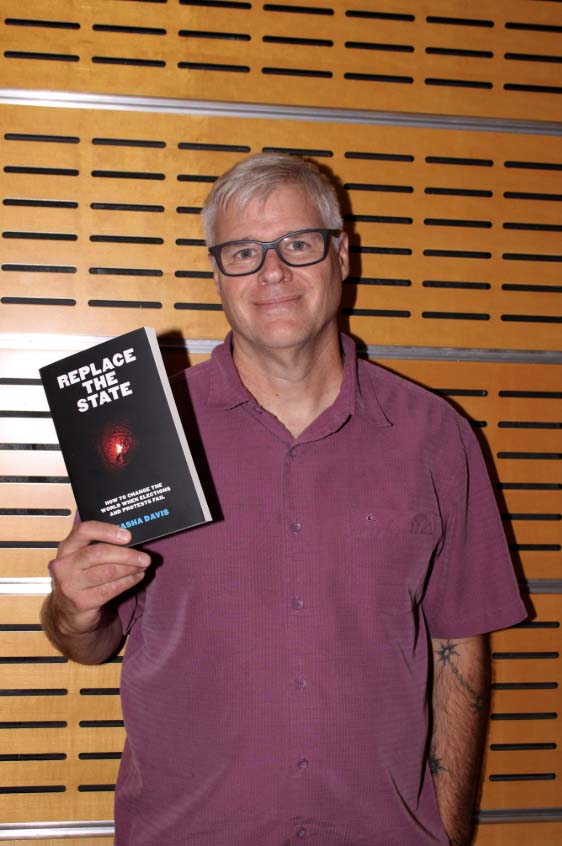


Coming off a national tour, Sasha Davis has officially launched his third book, “Replace the State: How to Change the World when Elections and Protests Fail.”
Davis, department chair of environmental studies, geography, and sustainability at Keene State, hosted a detailed discussion on the contents of the book on Wednesday, Sept. 10.
An audience of students, colleagues and those eager to learn more about what “replacing the state” means filled the seats of room 101 in the David F. Putnam Science Center, engaging with Davis as he outlined core themes of the book and prompted those in the room to share their thoughts on the weight these themes carry in our current political climate.
The thesis of “Replace the State” is, according to Davis, “even if you can’t exercise effective power at the scale of the national government, you can at other scales that matter.” Built upon research gained through Davis’s first-hand experience of observing political protests in Hawaii, South Korea, the Philippines, Micronesia, the Marshall Islands and Okinawa Island of Japan, Davis said his book works to provide readers an understanding of the ethics of good governance, and how to rise up when ethical standards are not being met within their government.
Through “Replace the State,” Davis urges that people cannot rely on institutions of The State to self correct and provide them their basic rights. Instead, people must create their own concrete plans as communities for governance and work to institute said plans effectively in order to take back power from oppressive systems.
“Protests cannot simply be protests,” Davis said in his discussion. He went on to explain that people cannot simply react to oppression, they must develop legitimate ways of dismantling it and be prepared to exercise these ways to create a better quality of life for all within their community.
Chris Liazos, a master’s student studying at Antioch University in Keene, works closely with Davis and attended his discussion. Liazos said the most important thing he has learned from Davis is “systemic thinking– how to embrace vision and not react to a system, but create a system that works for your values.” This ideal encompasses much of “Replace The State” and is a key component of Davis’s life’s work.
Molly Dyer, a senior at Keene State, was also in attendance. According to Dyer, Davis has had a particular impact on her as a student. “[Davis] is my favorite professor, and I want to support what he does,” she said when asked why she chose to attend the discussion. Dyer said Davis has taught her that “local action can make big changes,” an overarching theme of “Replace the State.”
Lauren Hubele, a local Keene resident, said she attended because she has heard Davis speak before and is “excited about what he has to say.” When asked what the most memorable thing she has learned from Davis is, she replied with one word, “Hope.” Hubele then expanded on this thought, saying, “[Davis] gives hope. He is speaking and people are listening, and what he’s saying appeals to all generations.”
“Replace the State” can be purchased online through the University of Minnesota Press website.
Serena Taylor can be contacted at
staylor@kscequinox.com