

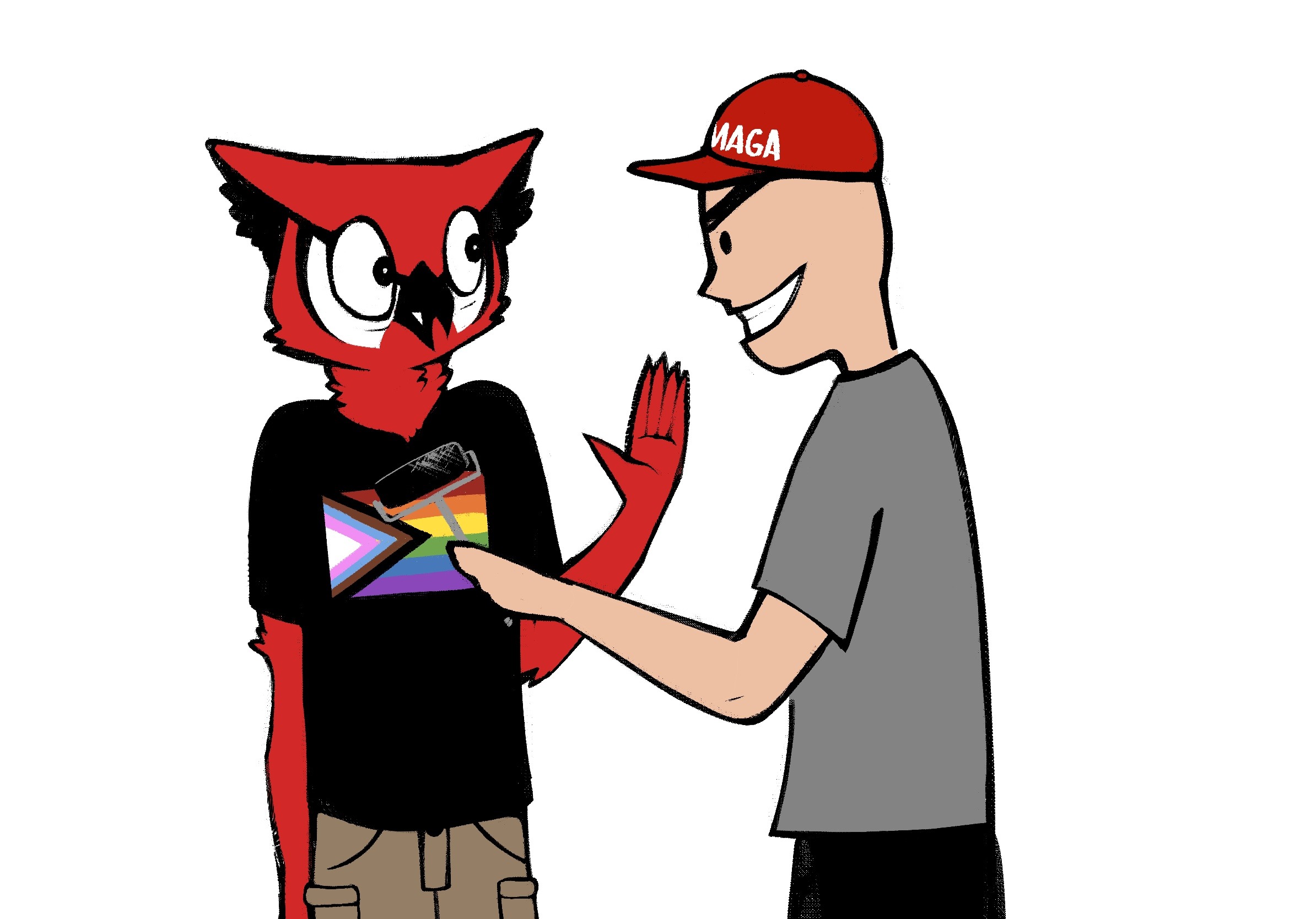
Many Keene State students and alumni will have at least heard the name Dottie Morris, if they haven’t actually seen or met the associate professor. Many of those students and alumni will also know that she is or rather, was, the head of our Justice, Equity, Diversity and Inclusion program.
Now, thanks to Gov. Kelly Ayotte’s signing of HB2 into law at the end of July, that moniker no longer stands. So what does someone in this position do? In Morris’s case, they fight. Morris, the American Civil Liberties Union (ACLU), and several other plaintiffs, including the Dover and Somersworth school districts, have filed a federal lawsuit against the state of N.H. They claim the bill is anti-free speech and that its language regarding what counts as a violation is too unclear.
HB2 is a sweeping bill that makes a myriad of changes to how the N.H. government’s money is spent. Nestled in the nearly 300-point analysis of what HB2 establishes, point 169 “[p]rohibits all public entities from implementing, promoting, or otherwise engaging in any diversity, equity, and inclusion DEI-related initiatives, programs, training, or policies.” It also means that institutions found to be in violation could lose their funding altogether. This is just one of many bills like this that have been sweeping the nation since the inauguration of President Donald Trump’s second term. The often Republican proponents of these bills state that DEI programs are in themselves discriminatory, that they advantage one group over the other.
Giving a quick glance to Merriam-Webster’s Dictionary’s latest definition of the verb “to discriminate”, this argument seems to hold water, but although their dictionaries are, in my experience, quite reliable, the makers of Merriam-Webster have neither the time nor resources to explain what discrimination looks like in the socio-economic context of the United States. While yes, white, cisgender, heterosexual men are not included in DEI programs, one could say this is an on-paper example of a discriminatory practice. But this particular discriminatory practice exists as a means to check and balance the inherent function of American institutions.
It is a fact that people of color in the U.S. do not have equal opportunity when compared to their white counterparts. Studies have shown that job applicants with stereotypically African-American-sounding names are less likely to be even asked to interview, much less actually be hired.
Our state, and indeed our nation’s, DEI programs seek to provide balance to this issue. Republican proponents of the latest anti-DEI legislation seem to think that we live in a post-racial utopia where these minorities are on an equal playing field with any Tom, Dick or Harry whose immigrant ancestors were lucky enough to be incorporated into “whiteness” by the end of the 20th century. But this simply is not the case.
Our nation is very young. The tricentennial of the United States is just over 50 years away, and the ghosts of slavery and indigenous genocide are barely even ghosts. The impulses that drove the first European settlers to those wrongdoings still rule the function of our country’s social, economic and political climates. That doesn’t just magically disappear because a politician says so, and it gets much worse when they actively erase the policies and institutions attempting to level the playing field.
May Cassidy can be contacted at
mcassidy@kscequinox.com