
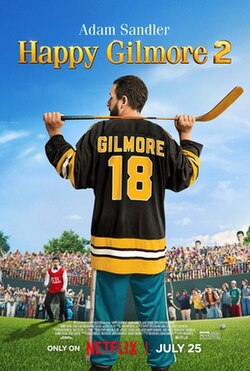
Nearly 30 years after Adam Sandler first brought audiences to their “happy place” with the 1996 golf comedy “Happy Gilmore,” Universal Pictures has passed the torch to Netflix to reprise Sandler’s role as the titular black sheep golf legend with “Happy Gilmore 2,” which was released on Netflix in mid-to-late July of 2025.
Borrowing liberally from the plot of the original, “Happy Gilmore 2” finds Happy once again on the verge of financial ruin, begrudgingly pushed into the world of championship golf in order to earn money for a loved one. Lurking in the backdrop of Happy’s comeback is a scheming rival, determined to undermine his success by any means necessary. Despite mounting pressure to rise against his own personal challenges, a supportive cast of loved ones pushes Happy to overcome the obstacles and remember what he’s fighting for.
If any of this sounds familiar, it might have something to do with this being the exact plot of the first movie. Under most circumstances, I’d be easily inclined to claim a copycat story structure as cynically cheap nostalgia bait. In this case, leaning heavily into nostalgia offers a rare strength that is usually butchered by other sequel attempts.
“Happy Gilmore 2” manages to play up the nostalgia in a way that helps the film to replicate the feel of a goofy ’90s comedy, without feeling forced or lackluster. Returning cast members, including Ben Stiller and Christopher McDonald, are not used as recycled throwaway cameos, but occupy the same energetic spaces within the ensemble as in the first film. Many of the original’s iconic gags are rekindled with a near shot-for-shot remake. Even characters who didn’t return are brought back in proxy as descendants of the originals, or obvious narrative homages to their 1996 counterparts.
It would almost feel gratuitous if it weren’t so on-the-nose and intentional. By leaning heavily into nostalgia, it becomes part of the joke and lends itself to what makes the movie feel as cozy and endearing as a genuine nineties Sandler comedy. The nostalgia is part of the bit.
“Happy Gilmore 2” manages to replicate the goofy energy of a real ‘90s-to-early 2000s comedy in a way that could have easily skewed detestable if not handled with the care and whimsy Sandler is known for.
In an age where remakes and sequels seem to poison the creative landscape with careless corporate nostalgia slop, Sandler and the team at Happy Madison Productions have managed to remind us that remakes can be more than the decaying corpses of once-loved franchises. Unlike recent sequels like “Top Gun: Maverick,” the heavy reliance on nostalgia doesn’t come across as desperate or out of pocket, but right at home in the absurd story it’s built into. In a world of cinematic shanks and bunker shots, “Happy Gilmore 2” hit this one dead center onto the fairway.
Ryan Pacheco can be contacted at
rpacheco@kscequinox.com