
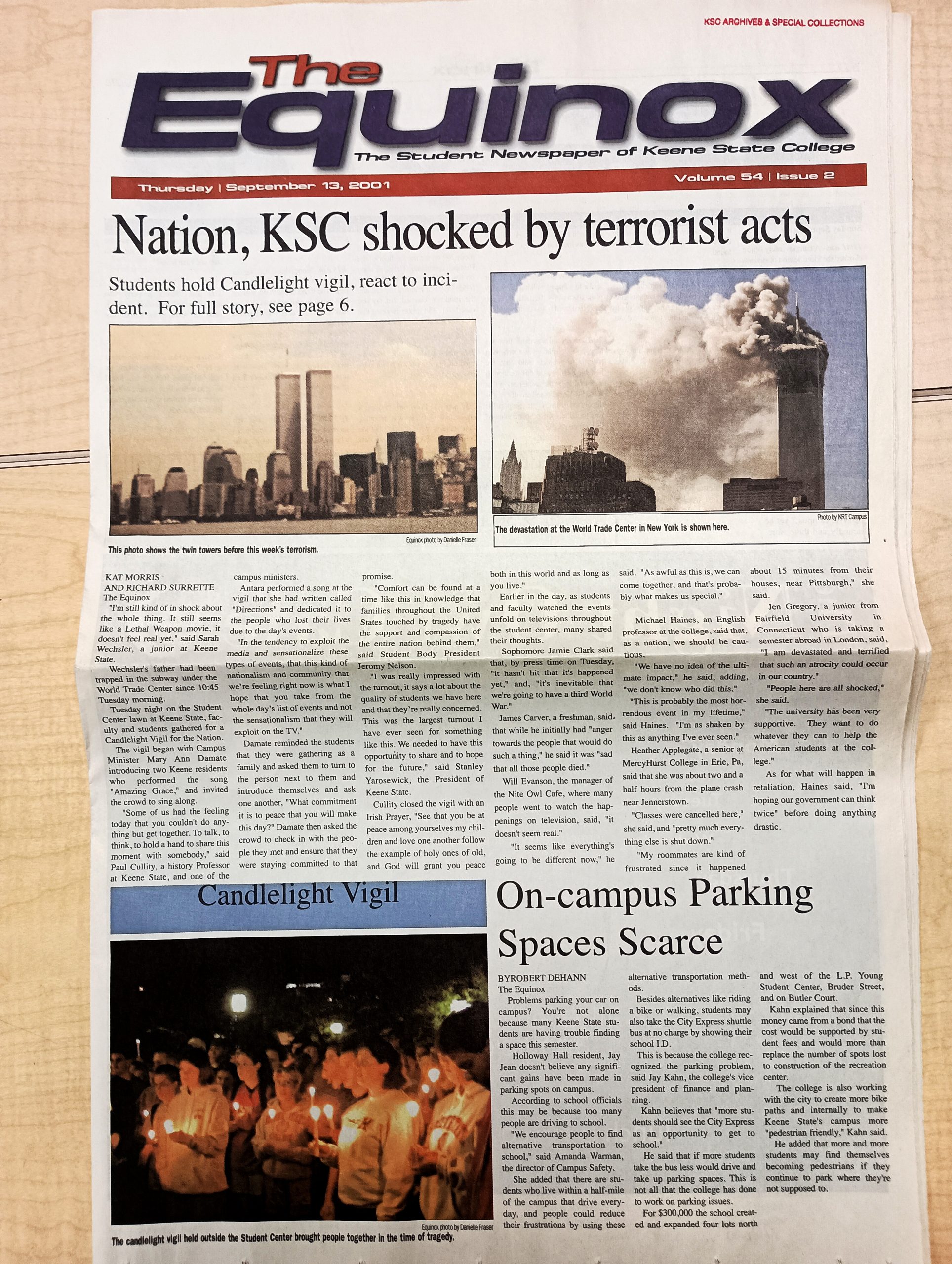
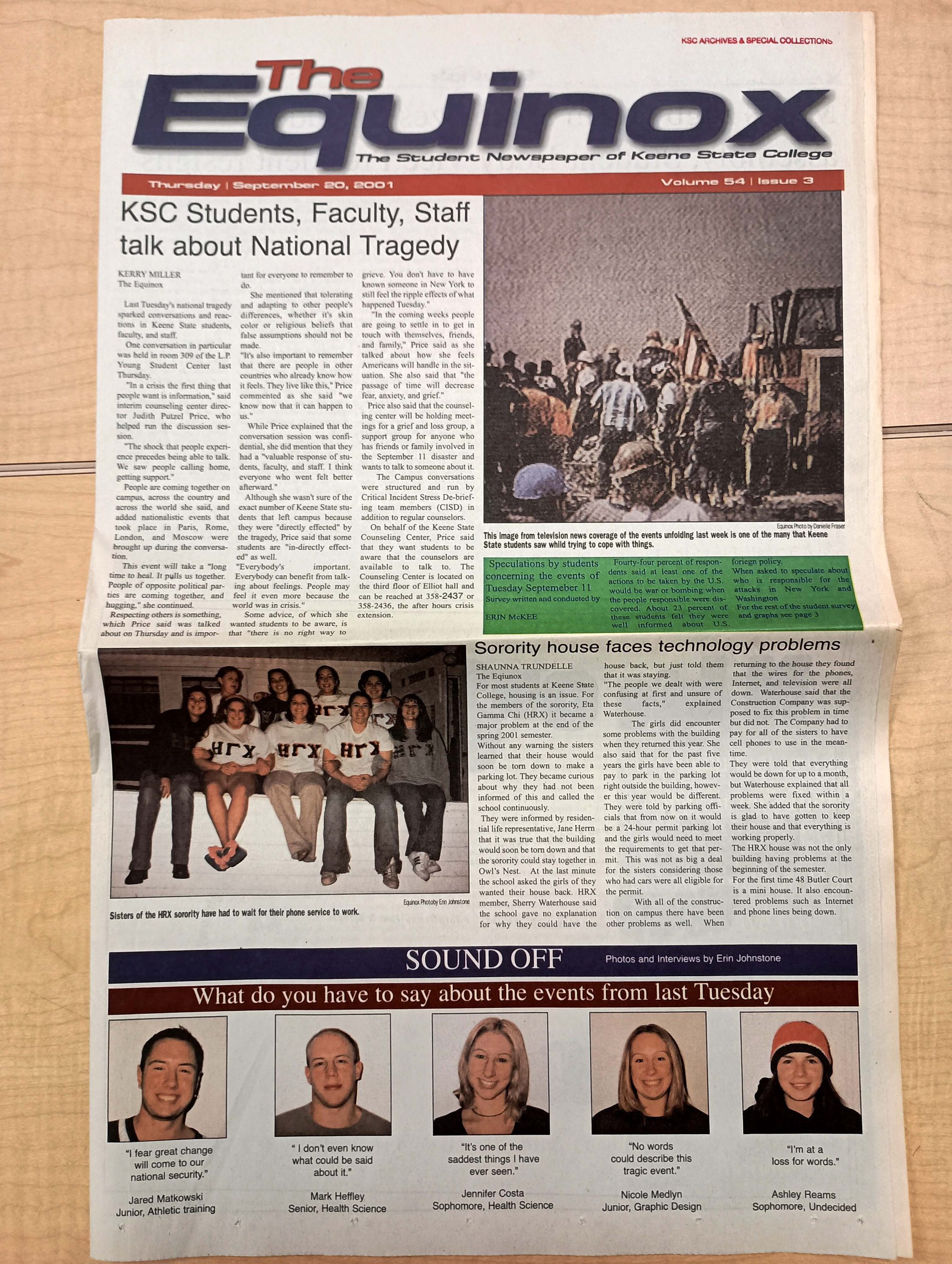
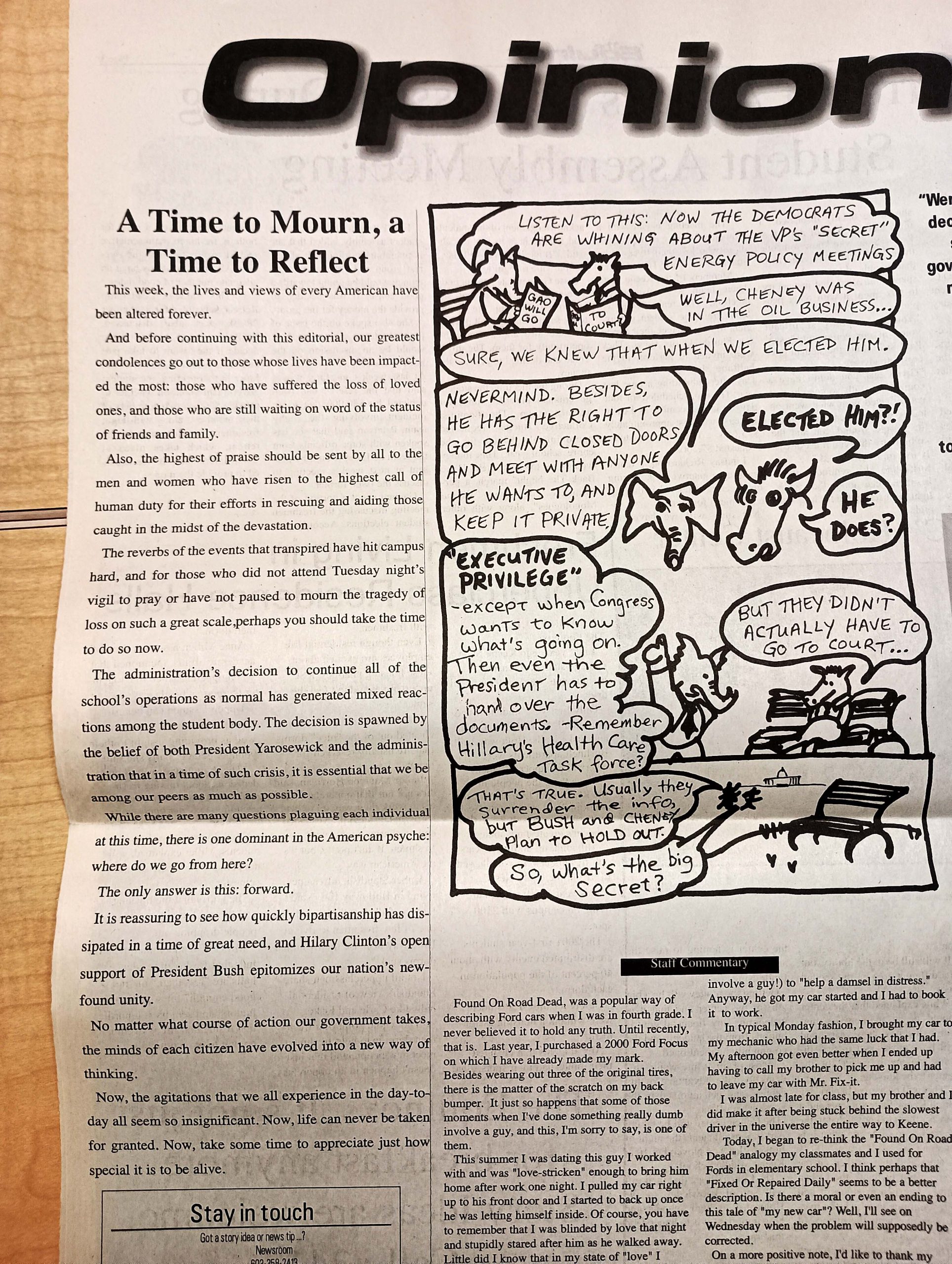



24 years ago, the United States of America was changed forever. With it, so too was Keene State College.
It is often said that one never forgets where they were or what they were doing when they first learned of the airplane attacks on the World Trade Center, commonly known as the Twin Towers, as well as the Pentagon, that occurred on Sept. 11, 2001. For KSC Accreditation and Assessment Officer Kim Schmidl-Gagne, that moment is tied to her career at the college. At the time, she was on the job as community director for Holloway Hall.
“As a professional with 300 and something students in the building, I centralized myself in the Holloway Great Hall,” Schmidl-Gagne said. “We moved to pull people together in a space where we could gather and watch things and check on things.”
Schmidl-Gagne said a lot of KSC students live in Connecticut, with family members who commute to New York City. She said one of the important topics that came up in the college’s response to Sept. 11 was figuring out which students were most likely to have been affected so they could receive whatever support they needed.
Schmidl-Gagne said one of the biggest long-term changes to campus was an overall increase in security, particularly in the dorm halls.
“As we needed to make changes in terms of security, there wasn’t a lot of pushback,” Schmidl-Gagne said. “People seem to understand the whys of it. … I think people were much more split on the war and not wanting to hold a whole people accountable and then it became clear that maybe we don’t have all the information and it got harder.”
Professor of History Greg Knouff also has a memory of the day of the attacks. He said that day, he was teaching a class about modern US military history, and instead of delivering his planned lesson, he hosted a conversation with his students about the news coverage unfolding in real time and what the group of students thought it meant.
“People weren’t fully grasping what was happening. A lot of people had not heard of Al-Qaeda,” Knouff said. “It was pretty traumatic as it was happening. … We had the news on in the background because I believe there were televisions in the classes back then.”
Knouff said the days following the attacks shared similarities with the immediate aftermath of the COVID-19 outbreak in 2020, especially the initial feeling that it would be a relatively temporary adjustment.
“There was this initial sense that this would be over quickly, that Al-Qaeda would be dismantled in a matter of months, which, as we well know, turned out to be the opposite of the case,” Knouff said.
Knouff added that commemoration events were held for about five or six years following the attacks.
“Over time, that disappeared from campus,” Knouff said. “Some of it is just obviously generational when you have people like my own son, who was born two years after 9/11, when the United States invaded Iraq. [For] people who don’t have any memory of it, it becomes more of a historical event.”
Knouff also spoke about the significance of 9/11 in American history as a whole.
“It’s a watershed event. There’s not a lot of them in American history,” Knouff said. “The beginning of the Civil War, the attack on Pearl Harbor, certain things that changed the trajectory of the country for a substantial period of time.”
Knouff elaborated that 9/11 brought an end to a period of time when Americans largely felt the Cold War period of tension between the US and the Soviet Union had come to an end.
“[9/11] was a wake-up call that things are going to be rough,” Knouff said. “They are going to completely change. I really do think it remade American society. A lot of things that we never did before, holding people in Guantanamo Bay without a charge, these were all new things at that time. … It was a moment of national trauma and surprise.”
Charlotte King can be contacted at
cking@kscequinox.com