
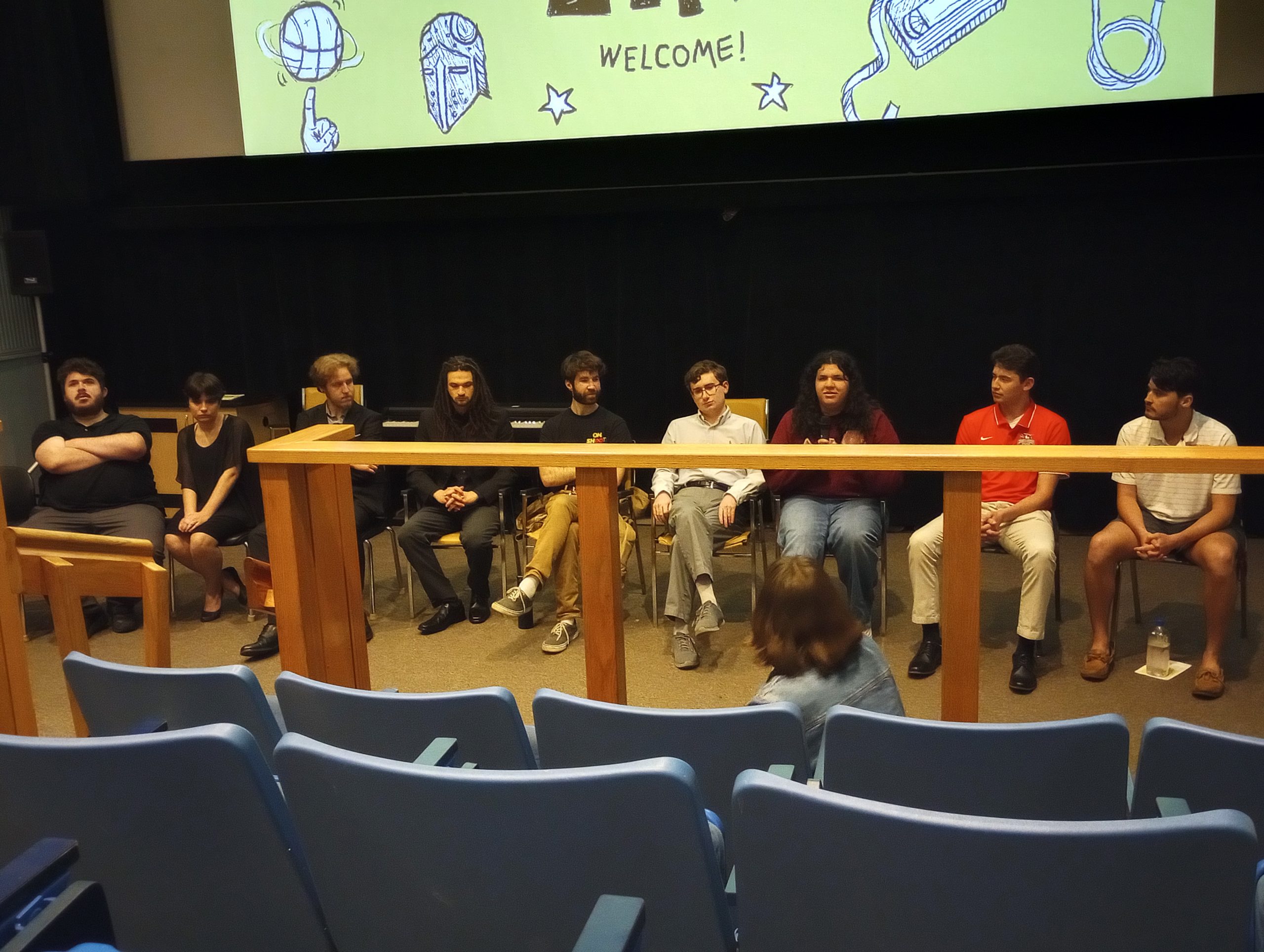
Four years of school, one year of capstone: That’s what the film department’s seniors went through, and the culmination of all of their work was presented at the Capstone Film Festival held on April 26 and 27 in the Putnam Theater for the first time.
This festival has been a long-standing tradition of the film department, according to Ted White, a clinical associate professor in the film studies department.
“Films are made to be seen, and traditionally the context for this has been in-person, in public on a big screen where the audience’s reactions–their laughter, their applause are part of a powerful shared experience,” White stated. “It’s still fun to watch a good movie on your phone or laptop by yourself or with another person. But there is just no equal to seeing a compelling movie amongst a large group.”
For film seniors, their capstone project is to use the year to make a short film. By taking a year-long capstone class, they work through making a film in the stages of pre-production, production and post-production, according to Associate Film Professor Taylor Dunne, who teaches a capstone class.
“They have to find locations, actors, the whole thing, and then they shoot it usually towards the end of the fall semester, over winter break or even early spring; that’s the production phase,” said Dunne. “Then post-production is editing, doing sound, color, all of that and then just showing cut after cut to the class to get feedback.”
White, who has also taught capstone, stated that the capstone project has evolved over the 20 years he has been a professor.
“When I first came to KSC, the capstone process was different than what it has evolved into now. There were just two crews that were very large–10 or 12 people, and each crew would make one film. The films were almost always long narratives – no documentaries or other genres,” White stated. “Over the last several years, we’ve gone to a new model in which we allow smaller groups making a more diverse range of genres…”
Because of the new projector in the Putnam Theater, this year was the first time the festival was held outside of the Redfern Art Center, which is the larger of the two venues.
“It’s just a really cool way to inspire other students in the school and to show a high caliber work of what’s possible by going through the program,” said Dunne. “And also just to share work with family and friends.”
There were 11 films in total, split into two programs, both of which were constructed by Dunne. Program A, consisting of six films, played at 1 p.m. on April 26 and at 5 p.m. on April 27, while Program B played at the opposite times on the same days.
Program A consisted of the films “Breaking the Ice,” “Stitched,” “Piecing the Remnants,” “The Immortal Garden,” “2017,” and “Oh, Shoot!” The program lasted about two hours, playing the films back to back.
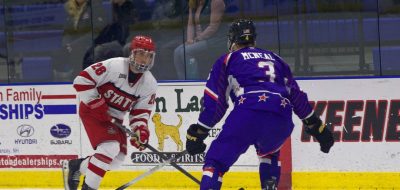
“Breaking the Ice,” the longest film in Program A, was a documentary about KSC’s inaugural women’s ice hockey team and their season, with clips from games and interviews with people involved with the team, some examples being some of the hockey players and Keene State College’s President, Melinda Treadwell.
It was directed by senior Joshua Rose, who also played a role in the editing and cinematography of the film. He said he had been presented with the idea in the spring of the last academic year and has been interested in film since he transferred to Keene State two years ago. He described the film as “a clean slate where players and coaches had to figure out how things worked as the season went along.”
“My favorite part of the filming process was getting to know all the women ice hockey players and basically being a part of the team!” Rose stated. “I went to almost every game, home and away, would ride the bus with them and have post-game meals with everyone!”
Along with Rose, capstone senior Reed Rampinelli was the sound recordist and also helped edit, along with another capstone senior, Ethan Davis. Junior Chloe Givens, capstone seniors Riley Bergstrom and Cameron Isbel were cinematographers for the documentary.
“I would like to thank my crew for all their help throughout the process of creating this film!” Rose stated. “A huge thank you to the Women’s Ice Hockey team and Abe Osheyack [Associate Athletic Director], Marty Testo [Director of Athletics], Kyle Biermann [Sports Information Assistant] and Melinda Treadwell!”
Next was the only animated capstone, “Stitched,” a stop-motion horror film that focuses on a character trying to escape a mad doctor who takes body parts from his prisoners to make his perfect creation. Although the film was made in a room in the Media Arts Center, the director and animator, Jasmine Jordan, said she made sure to play with atmosphere within the film. Jordan said she started with the idea of someone trying to escape some sort of monster and later thought of the mad doctor character.
She said although she hadn’t done much stop motion and animation outside of projects for class, she had loved animation for a long time.
“I think with animation, it’s just something I was always interested in,” Jordan said. “I just love watching films, and I always pay attention to facial expressions in animation, and also just stop motion. I’ve done it for a while, ever since I was little, like with Legos.”
Junior Patrick Garcia did the sound for the film and Audiovisual Operations Coordinator Trinity Nay, who is Jordan and Garcia’s boss, composed the project.
“The tech team has helped me a lot with both sound and music and just like was really encouraging. And also Ted White, who was also very helpful. He helped me get a place to animate it [“Stitched”] and was also very kind and when I had my doubts he helped me tell me a lot of the time that I could do this, which helped me a lot to keep going,” Jordan said.
Next up was “Piecing the Remnants,” the first narrative film of Program A. Senior Jacob Conway said he started with two separate ideas, but then melded them together into the story of Logan by telling it in a more non-linear way. The story follows the most important stages of his life, like living with his two parents and then living with his first girlfriend.
“I am a strong advocate for mental health and stuff, and that story is very focused on dealing with mental health and talking about it, and then accepting it and then figuring out multiple different aspects to make it help because that’s what I’ve done in my journey,” Conway said. “No matter the variety, there’s always hope for you to accept and then there’s people that want to listen.”
Murphy Fitts, a KSC ‘23 alumnus, produced the film along with Conway, the director and editor of the film. Capstone senior Jace Arsenault was the cinematographer of the film, who also helped with storyboarding. Conway also said he wanted to thank his parents, the film department, Dunne for inspiring him through her classes he was in and his cast and crew for “killing it.”
“I remember more on-set stuff than the shots, to be cheesy, but it’s always a good time … It is stressful and it’s a lot of work,” Conway said. “Making this movie, starting in September, and then it just finished last weekend, like that’s a lot of time, more time than I’ve ever committed to one single thing, and it was such a big learning curve and I hope that doesn’t discourage people. The stress and the mental exhaustion is worth it.”
Although the next film was only five minutes long, “The Immortal Garden” was an experimental film that was filmed on a 16 mm camera. While taking a more artistic approach, the creator of the film, senior John Martin, was inspired by his own experience with dealing with mortality and life itself. Martin was not able to be contacted before the deadline. The film was edited by senior Caesar Barboa, who stated that the film was “an appreciation of the morbid cycle.”
“It represents a reflection on the idea of the cyclical nature of life, decay, and dying. The meat featured in the film was created from animals who died, and the meat rots and decays while bacteria and other organisms eat away at it, which eventually turns into something else,” Barboa stated. “It’s not ‘reincarnation’ in a sense, but there is a comfort in the idea that we become something else even after death.”
Although Barboa said she is not going to continue with film after college despite her passion for it, she reflected on her amazing time she has had within the film program and how the process of making a film is both rewarding and challenging to learn.
“I would like to thank Taylor [Dunne], Ted [White], and John [Martin],” Barboa stated. “This capstone project has been more than I could have asked for in terms of flexing my editing muscles one last time, showing off my skills and putting everything I’ve learned into something. Without them, it wouldn’t be possible.”
“2017” was another documentary, but it was far from what “Breaking the Ice” was focused on. The director and editor of the film, senior Joe Craighead, made the documentary by interviewing friends and family members of his father Rodkey and his brother Andy who both died in the year 2017. While the film was mostly made of these interviews, which took him from October 2024 until January 2025 to gather, there were some clips that were shot of him grabbing seashells off of a beach.
Craighead always wanted to have his capstone something that was personal to him, and the film allowed him to reconnect with people who were close to either of his two family members who had passed.
“Finally in my everyday life I always try to do the things that my father and brother would want me to do and to live life to the fullest, and I always knew that losing the both of them would be the idea for my film, but in a weird way making this film allowed my to feel closer with both of them and the people in their lives and that is something that I will continue to take with me through the rest of my life going forward,” Craighead stated.
Junior Eamon Matthews did the cinematography, helping Craighead with recording some of the Zoom call interviews within the film, and capstone senior Jasmine Jordan did the sound, helping with Craighead’s voiceover narration.
“I have realized that everyone is this world has a story and you might not know what someone is going through or dealing [with] but the only way to grow from it and become stronger is to be open to share your story and how it affected you, and that just because you have flaws or tragedies in your life, that shouldn’t define who you are and limit your potential and you can do anything if you set your mind to it,” Craighead stated.
Craighead thanked the friends and family that were willing to interviewed, Jordan and Matthews for helping with the film, Dunne and White for their guidance and Film Studies Department Chair Jo Dery for encouraging him to trust his skills as a filmmaker and persevere.
To end off the first program, Wilson Hines’ “Oh, Shoot!” was a narrative film that focused on an amateur film student trying to make his first film before he graduates college. Hines described the film as a “drama” with comedic, romantic and thrilling elements. Although the story is fictionalized, the main character was based on Hines’ past experiences, fears and struggles in his own life with filmmaking.
“My favorite part of production was probably coming home after a long and exhausting shoot day to look at the beautiful clips we would get from that day,” Hines stated. “I would throw my most anticipated clips into my timeline and see right in front of me how worth it the whole process was.”
Hines stated he has loved to film and perform for as long as he can remember, although he did not realize that for a while until he started posting on his YouTube channel in 2015, and continued to make projects ever since. He stated he is excited to continue to make films after he graduates, stating that he already has plans for his next film, possibly looking into delving into the horror or thriller genre.
Braedon Ledder, a 2024 KSC graduate, was the cinematographer for the film. First-year Thomas Lambert stepped in as the sound recordist.
“I’d love to thank my entire cast and crew for being such great people to work with and so committed,” Hines stated. “Thank you to all the donators who made this film come true, my capstone professor, Taylor Dunne, for telling me I need to make a film, and thank you to my close friends and family for believing in me.”
For Program B, there were five films, “The Oath,” “Reflections,” “Black Diamonds,” “Poker Night” and “Beyond the Nest,” totalling about two hours and ten minutes.
“The Oath,” directed by Liam Wells, was first up. The film is a medieval story about two outlaw brothers, Cassius and Arturus, going on a quest to find a cure for a disease they have been plagued with known as The Dread. The two brothers face many spiritual and physical challenges throughout their journey, centering around a theme of morality.
“The contrast between the ruthlessness of the marauders and the wholesomeness of Arturus really make the film special to me,” Wells stated. “I think the journey that Cassius takes is really important as well because it shows how he learns from his past and becomes pure because of what Arturus and Luscian showed him.”
Wells also mentioned his excitement about making more films in the future, as well as how he thought the whole process was really fun.
“Going into this film, I knew it would be the largest project I have worked on, and I knew it would be a defining moment for my film career at Keene State,” Wells stated. “I really loved having a huge cast and crew, it really felt like a huge filmmaking family, and this made The Oath feel like a real, and professional film to me.”
The seniors who worked on it were Jace Arsenault and Julianna Soucy as cinematographers, Brodie Vowles as an editor and Cam Perroni as a sound recordist and one of the marauders. Senior Ryan Severn also played a marauder, and senior Nate St. Cyr was a production assistant. Juniors Benjamin O’Connor and Mariah Rodriguez-Costa were the producers of the film.
“I want to thank my family and friends who helped me make this film possible, and anyone who contributed to our fundraiser, as well as Ted White and Taylor Dunne, who were my capstone professors for this year-long production,” Wells stated. “I would also like to thank the actors for Cassius and Arturus, [first-years] Jackson Schimpf and Brad Herlihy, as they were fantastic actors to work with and really brought the characters my crew and I had written to life.”
Following the medieval adventure of “The Oath” was the experimental horror film “Reflections,” directed by Benjamin Harley.
“I think the character we see the most in film ‘Luke’ is the heart of the film, and his journey through growing out of this thing that scarred him and then being reborn out of it and finding some semblance of self-acceptance is really what the film is about,” Harley stated. “This is important to me as trauma is a topic I take seriously, having seen how it’s affected people firsthand, and I wanted to approach it in a nuanced way, and I think the experimental aesthetic helped with that.”
Harley stated that he is excited to continue to make films, although he is going to stay away from the experimental genre for a while.
“Making this film was fun, and I’m proud of how it turned out, but it could get a little numbing sometimes going over so much dark material,” Harley stated.
He stated he could see himself trying out a comedy, drama or small-scale action film in the future.
Conway was the associate producer of the film. Even though he had never worked with Harley before, he said he was interested in helping when he heard that his capstone film was based on a previous film he made, “Shadows,” which Conway had seen at a KSMP film festival.
Harley also stated he included themes of trauma, as well as negative interactions with society, so Conway said he “wanted to work with somebody in a totally different genre who also respected the same things I did.”
Harley thanked his entire crew, his professors Dunne and White, the KSC film cage faculty members, and his immediate family for their support, as well as anyone who donated and raised attention for his film.
For other capstone seniors who worked on the film, there was Colin Murphy as the assistant director, Peter St. Germain as the art director and main editor and Jace Arsenault as the director of photography. Junior Ben Martins was the sound recordist.
Keeping the program rolling, “Black Diamonds” was up next, a brief 20-minute documentary about the Makusue ski and sport club in North Conway. It was directed by Leo Tufts and produced by his father Peter Tufts.
“My film was about ski club culture in North Conway, specifically focusing on the Makusue Ski and Sport Club,” Leo Tufts stated. “It was important to me to show a sort of hidden and timeless culture that began back around the 50s and is still going today.”
After this capstone, which Leo Tufts mostly did by himself, he stated he wants to focus on helping others with their films rather than starting one from scratch.
“I would love to thank my dad for all his incredible help with the project, driving me around and helping me get information,” Leo Tufts stated. “As well as my mom, for encouraging me to keep going, the Makusue ski club for their support and enthusiasm, and Ted White for believing in me and helping me with the technical aspects whenever I needed it!”
“Poker Night,” directed and written by Nathan St. Cyr, is a black comedy film about a night of poker with friends that escalates as tensions rise as past events are brought into the game.
“I have always been very interested in the dynamics of male friendships, so it was important to me to try to capture that familiar banter, bickering, and muted love on screen,” stated St. Cyr.
St. Cyr stated he realized his love for film during the COVID-19 pandemic after having to submit weekly vlogs for his economics class. He stated his favorite part of making this film was the collaborative process that filmmaking entails, and how seeing talented people working in their element on set gives an “inspiring feeling that makes you want to do even better yourself.” Even with the ups and downs he has had with film, this project has inspired him to continue making films after he graduates.
The cinematography and sound design was done by Severn. Perroni was the sound recordist for the film, senior Deven Ferguson was the editor and gaffer and junior Mariah Rodriguez-Costa was the producer.
“I want to thank my entire crew for their unrelenting talent and effort throughout this project, as well as my family for supporting me at college,” St. Cyr stated. “I would also like to specifically thank my dad for inspiring my love of film.”
To finish off Program B, “Beyond the Nest” was a sports documentary following KSC’s new men’s basketball coaching staff for the season leading up to the team’s fourth consecutive Little East Conference (LEC) championship. It lasted 42 minutes, making it the longest film made in both programs.
Capstone seniors Riley Bergstrom and Cameron Isbel directed the film. Bergstrom, who had worked with the team for four years as a videographer, stated that he wanted to take a step up from his social media work and make a documentary.
“It was very crucial that our film was observational so that the audience could really get an in-depth look on the full basketball season so that they could really get to know the players and feel like they know them personally,” Isbel stated.
“Before making this film, I was pretty set on becoming a cinematographer with a strong eye for sports,” Bergstrom stated. “However, the documentary filmmaking process has taught me a lot, and it’s truly a special craft that I would love to continue pursuing!”
After 30 games with the team, Bergstrom stated the filming did get a little repetitive, but it was the off-court experiences that became his favorite memories of making the film, especially being a part of the moment when senior Octavio Brito received the news that he had won National Player of the Year.
“Each player brought such a distinct aspect to the project that really made the film shine,” Isbel stated. “There were moments where it’s sad, there are moments when it’s happy, and even sometimes in the sad moments, you can find something funny.”
The two directors were also cinematographers, accompanied by Joshua Rose, the director of “Breaking the Ice.” Capstone seniors Reed Rampinelli was the sound recordist, who also helped out with Rose’s film, and Ethan Davis was the gaffer and juniors Chloe Givens and Dylan Fadale were production assistants for the film.
“This project would have never been possible without the help and support of Head Coach Steve Enright and Assistant Coach TC Thacker,” stated Bergstrom. “Not only did they trust us, but they also put us in hotels with the team, let us ride the bus, and even fed us!”
“I want to thank the coaching staff and our crew. Without the support from the coaching staff this project never could have become what it is,” Isbel stated. “They really gave us full access to a portion of their lives even in the most intense moments and the same goes with the support from our crew.”
After all of the films were screened at each of the four events, a Q&A session was held with capstone students who were directors, editors, cinematographers and so on to talk about their inspirations, expectations and experience with making the film with the audience.
When the seniors were done answering questions and White and Dunne wrapped up the night, there was a reception in the lobby of the Putnam, where there were some small bites to snack on while everyone broke into conversation around the room.
Dunne said she knew all of this year’s capstone students, saying it was rare for her not to have had them in at least one of her classes.
“Some of them I know really well,” Dunne stated. “I’ve done independent studies with them, I was their teacher when they were taking Video One as a freshman, so yeah, I know them, and it’s really special to see them grow and mature as film artists.”
White shared similar feelings towards the seniors, stating that it has been amazing to “see them grow and change over several years.”
“I can’t tell you how thrilling it is to see this transformation where people gain such confidence through the process of challenging themselves creatively, intellectually and physically, while they’re putting in a ton of hard work along the way,” White stated.
Although the crews for the capstone projects were small, Dunne stated she thinks this is a safe space for film students, allowing them to get a start into what the future holds in the film industry.
Hayley Doda can be contacted at
hayley@kscequinox.com