

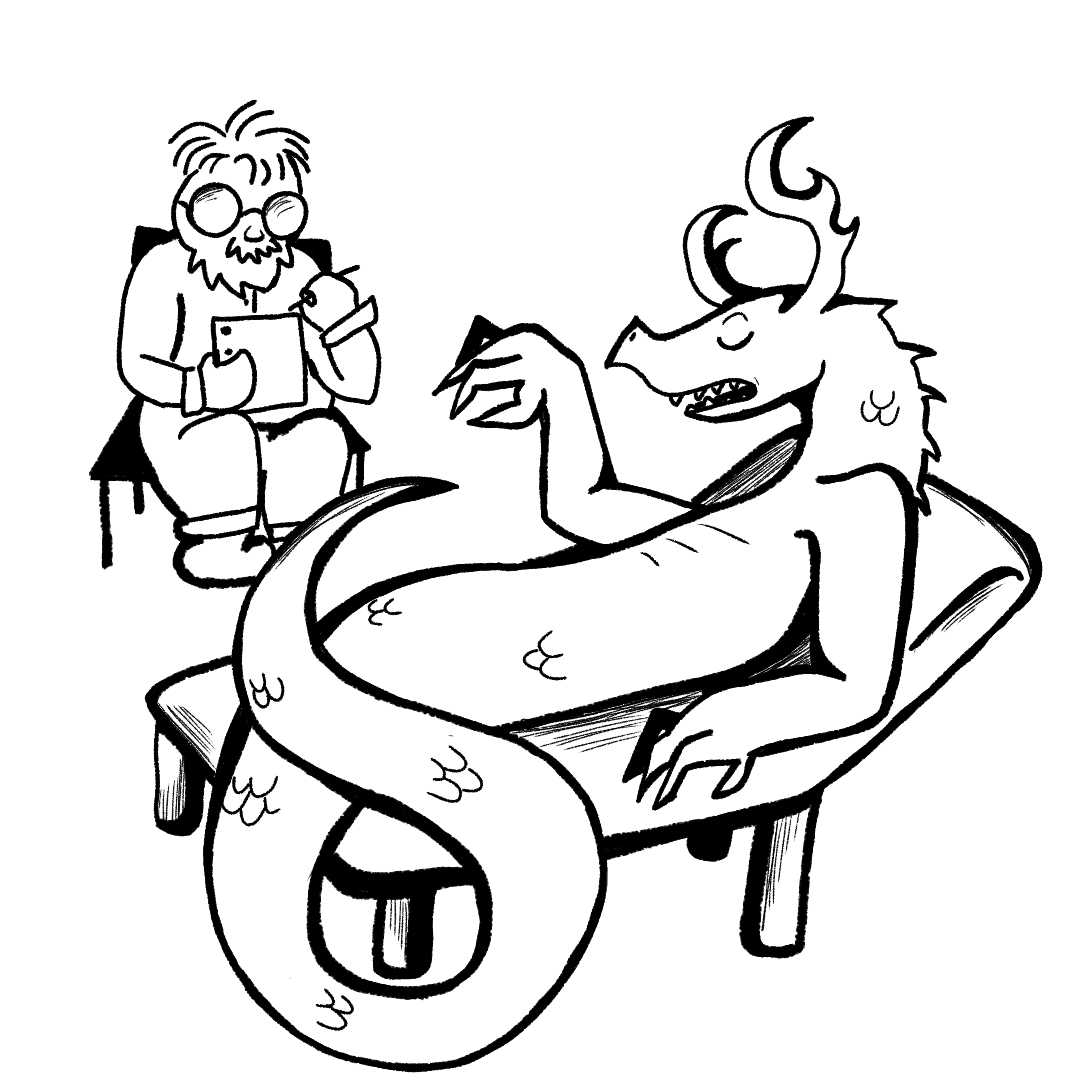
Dungeons and Dragons is typically associated with fighting monsters and going on adventures, but Keene State’s Wellness Center uses it in a different way.
Students may have seen the posters around campus advertising Dungeons and Therapy, a program that combines group therapy with tabletop role-playing games (TTRPGs), and been confused as to what it is or how it would even work. Michael Evans, one of the Dungeons and Therapy game hosts and wellness center counselors, explained just what the program is.
“The group takes the idea of group therapy and [TTRPGs] and combines it into one thing,” said Evans. “It gives people the opportunity to practice social skills, make connections … in a place that’s safe [and] welcoming.”
Evans continued, “If they’re interested in fantasy role-playing it just makes … the idea of group therapy a little more welcoming.”
The program began in February 2024 and meets on a weekly basis. Students are given a chance to create their own character based on their ideal goals or traits and advance through in-game challenges and adventures. The game is typically shaped by what the students want to focus on and accomplish.
Evans explained there have been a few changes to the program since it started. Most notably, they no longer use the Dungeons and Dragons TTRPG system.
“I switched to another [system] this semester, Dungeon World,” said Evans. “It’s a little bit less mechanic-heavy and a little bit more on the role-playing side of things.”
According to their website, Dungeon World is another TTRPG that focuses less on following rigid rules and more on what’s happening within the game itself.
“We noticed in past times that we’ve run [the game] the mechanics got in the way of actual therapeutic work,” continued Evans.
However, even with the successes, Evans said that there have been some challenges with attendance.
“Trying to get people to come seems to be a little bit difficult,” said Evans. “I don’t know if it’s a lack of awareness … it feels like there’s an interest but then we don’t get as many people as we expect there to be.”
According to Evans, there are usually about five or six students that show up to each session.
Each session begins with a check-in for all the students to remind everyone of what the story of the game has been so far and to present what the latest challenge is. The students then get to discuss how they want to approach and overcome the challenge, which might be a puzzle, a monster or something else entirely. The sessions usually last for one and a half hours.
“It’s more me being like, ‘Here’s the story,’ and then the group members taking it from there, working together,” said Evans. “I try to incorporate people’s goals into the story if I can. That can be a little bit difficult at times, trying to curate and narrate a narrative without making it too structured.”
Evans said while he has no current plans for change with Dungeons and Therapy, he is hoping to learn how to better intertwine the TTRPG elements and therapeutic elements.
“Every time I run it, I learn new things,” continued Evans. “So I’m trying to get better and better at doing it.”
Orion Corbin can be contacted at