

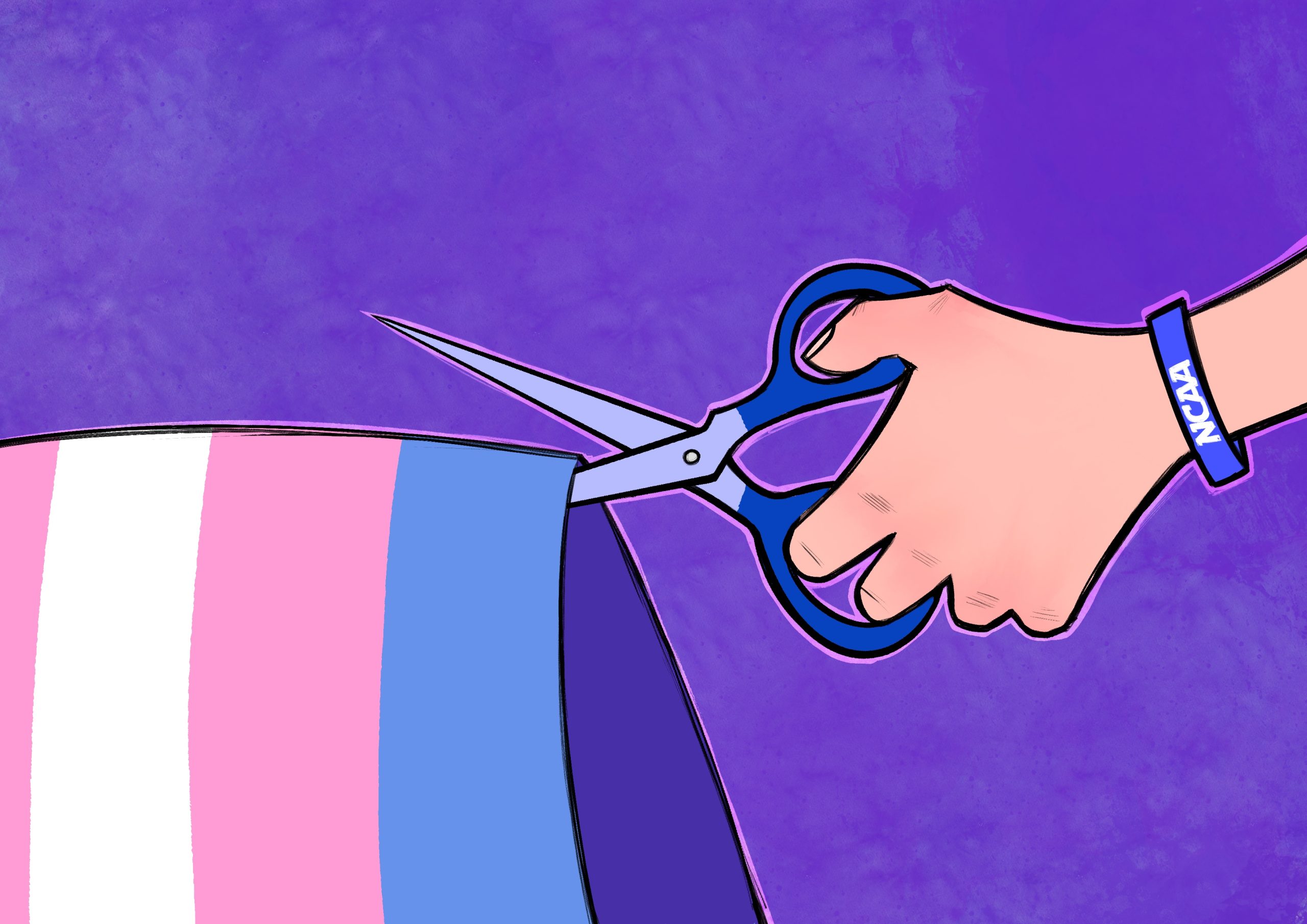
“[The NCAA’s] lack of standing ground in the face of an executive order that currently doesn’t have any legal standing shows a lack of spine,” said Ian Kaplan, coordinator of LGBTQ+ student support.
On February 5, NCAA President Charlie Baker announced in a statement the collegiate athletics governing body would comply with an executive order from President Donald Trump’s administration barring female transgender athletes from participating in athletic competition at schools.
The scope of the order and the legality of the action are unclear at this time. In the order, Trump threatens the use of Title IX regulations to pull federal funding from schools that do not comply with the action.
Keene State College is an NCAA DIII school, so varsity sports must comply with the order given by the NCAA.
KSC administrators react
Marty Testo, director of athletics, said his understanding of the order is that transgender athletes would be barred from competition but not from other team activities.
“It’s only barring them from participating in competitions right? That’s what the order says. They’re [transgender athletes] actually still able to participate in practice and things like that,” Testo said.
Testo added he hopes the order does not look to stifle any individuals from pursuing physical activity.
“I would never want to discourage anybody from participating in sport or physical activity. I hope that’s not the plan of this order, that will never be the plan from our department for sure,” Testo said.
He added he was unsure if the order applied to the college’s club and intramural sports offerings.
“We don’t have any information on that right now,” Testo said. “The order’s a little vague … You have to define sport now. We know intramurals and club sports aren’t [in] the governing body [NCAA] right? We have to stay tuned and see where it goes,” Testo explained.
Previous NCAA guidance released in January of 2022 stated transgender athletes could participate in competition if they met sport-specific eligibility requirements approved by the NCAA Committee on Competitive Safeguards and Medical Aspects of Sports.
The organization had a three-phase implementation plan that began in 2022 but has since been reversed following Trump’s order.
KSC President Melinda Treadwell, who serves on the NCAA DIII’s management council and president’s council, said she agreed with the NCAA’s previous guidance and was hopeful Trump’s order would be overturned in court.
“I think what will happen is we’re [KSC] going to be on pause while we try to let the dust settle a little bit and, frankly, I think that is a very good thing for all of us,” Treadwell said.
Treadwell noted she was not concerned with the college being out of compliance legally at this time.
“I am awaiting final [word] from our general counsel’s office at the system [University System of New Hampshire] level, because this is all happening so fast; I expect that we are compliant with the state,” Treadwell said.
Lisa Thorne, director of communications and outreach at USNH, gave the following statement to The Equinox on potential litigation.
“The University System of NH does not comment on current or potential future litigation,” Thorne stated.
Legal challenges
On February 12, two transgender student-athletes from a high school in Pembroke, N.H., were the first challengers to the order. The two claimed in a court filing that Trump’s order was “a broad intention to deny transgender people legal protections and to purge transgender people from society,” according to reporting from The New York Times.
A federal judge issued a preliminary injunction allowing the two girls to continue playing on their school’s soccer team.
Congresswoman Maggie Goodlander, who represents New Hampshire’s second congressional district, sent the following statement to The Equinox via a spokesperson.
“Being a part of sports teams made me who I am today. I believe that everyone in New Hampshire and across America should have the chance to be part of a team and to compete safely on a fair and level playing field,” Goodlander said. “As a former Division I athlete, I take Title IX and its protections for women and girls seriously. These unilateral executive actions — which are currently being challenged in federal court right here in New Hampshire — will not make sports safer or more fair.”
In recent years, the participation of transgender athletes in sports has become the focus of several legislative attempts both statewide and federally to regulate or ban transgender individuals from competition, citing concern for fairness in women’s sports.
In N.H., HB1205 was passed on July 26, 2024, banning transgender girls from grades five through 12 from competing in women’s sports.
However, on Sept. 10, 2024, the law’s enforcement was blocked by a federal judge who sided with the high schoolers, citing discrimination statutes.
Kaplan said the restrictive efforts are particularly harmful to the K-12 age group.
“Ultimately, it is exclusionary … K-12 sports is meant to be a largely social construct. The competition is really a secondary impact for students on their well-being and the way they are,” Kaplan said.
Fairness
Mel Adams, KSC professor of exercise science, said the concern of fairness when it comes to female transgender athletes is based on a false premise.
“When you look across genders, there are women who are bigger, faster, stronger than men and men [who] are bigger, faster, stronger than some women, but not all. It’s not a universal truth that being born a male is going to make you a better athlete automatically just by being a male,” Adams said.
Adams cited a 2024 study released in the British Journal of Sports Medicine that analyzed the differences in grip strength between transgender men and women and cisgender men and women, which ultimately found that, proportional to body size, transgender women had no advantage over cisgender women when it comes to strength.
“While longitudinal transitioning studies of transgender athletes are urgently needed, these results should caution against precautionary bans and sport eligibility exclusions that are not based on sport-specific (or sport-relevant) research,” the study’s authors concluded.
Adams said the issue of transgender participation in sports itself is also exaggerated.
“It’s overblown … the idea that trans women are taking over female sports because if that were true, every instance of there being a trans woman in a competition, that trans woman would have won,” Adams explained.
During Baker’s testimony to a U.S. Senate panel in December, he said there are “fewer than 10” transgender athletes who currently compete in college sports at the NCAA level.
In an email statement to The Equinox, Testo said he was unaware of any transgender athletes currently participating in any teams within the athletic department at KSC.
Adams said restrictions on hormone levels such as testosterone are also not the way to go in terms of regulating athletic competition.
“It’s interesting to me that we don’t go around measuring estrogen in men and saying to male-identifying athletes, ‘Oh, you have too much estrogen to be in this male category.’”
The issue lies within the desire for control of women’s autonomy, Adams said.
“This is a policing of women’s bodies that we would never think of doing for men and so I’m not really comfortable saying there’s some sort of cut off of fair or unfair,” she said.
Adams said she worries about the effect the action could have on efforts to promote physical activity.
“This paints a picture that sports and exercise and physical movement aren’t a welcome place for trans folks so we’re going to see years of results of those folks not being engaged and seeing a lot of health impacts from that,” Adams said.
The NCAA’s decision
Regarding the NCAA’s rapid decision to comply with Trump’s order, Adams said there was never as much of an effort by the organization to comply with Title IX’s original goal of elevating women’s sports.
“How amazing that, within 24 hours, the NCAA says that they will comply with this brand new order – not a law – it’s an executive order, that they will comply with that and yet it took over 30 years for Title IX to actually get some sort of level of compliance within the NCAA,” Adams continued, “I’m disappointed in that this is such a hot button topic that they could instantly turn the ship around and say, ‘OK, we’re going to do this.’”
According to the nonprofit organization Domestic Violence Intervention Services, no school has ever faced penalties or been stripped of funding due to Title IX’s regulations.
Adams said she thinks it is the responsibility of administrators and campus officials to not back down in the face of restrictive orders.
“I run a camp for trans and gender-expansive kids, and I’m not going to automatically comply. I don’t take any federal funding, I’ve got no sort of legal difficulties here … but I’m not going to preemptively comply,” Adams said.
In terms of Trump’s intentions with the order, Kaplan said they are irrelevant given the result is the same regardless.
“Whether or not it is coming from a place of genuine concern, it doesn’t change the fact that it is coming from a place of scientific inaccuracy,” Kaplan said.
Additionally, Kaplan noted his reaction to the NCAA was that of disappointment.
“I think the NCAA acted in a cowardly fashion,” he said.
Going forward
Kaplan explained it is disappointing to see the continued restrictive actions put forth given the real issues facing women’s sports.
“There’s still widespread issues where women’s athletic teams are not compensated the same way that men’s athletic teams are … There are problems in women’s sports where women are not treated as well by their coaches and counterparts as men’s teams are … If people were actually concerned about female athletes, they would be trying to solve gender equity,” Kaplan explained.
As for advice to the transgender community, Kaplan said it is important to find your community and feel supported during this time.
“Find your people, find the folks that are going to be advocates and make community around that because movements are built by numbers and people willing to back each other,” Kaplan said.
Nathan Hope can be contacted at