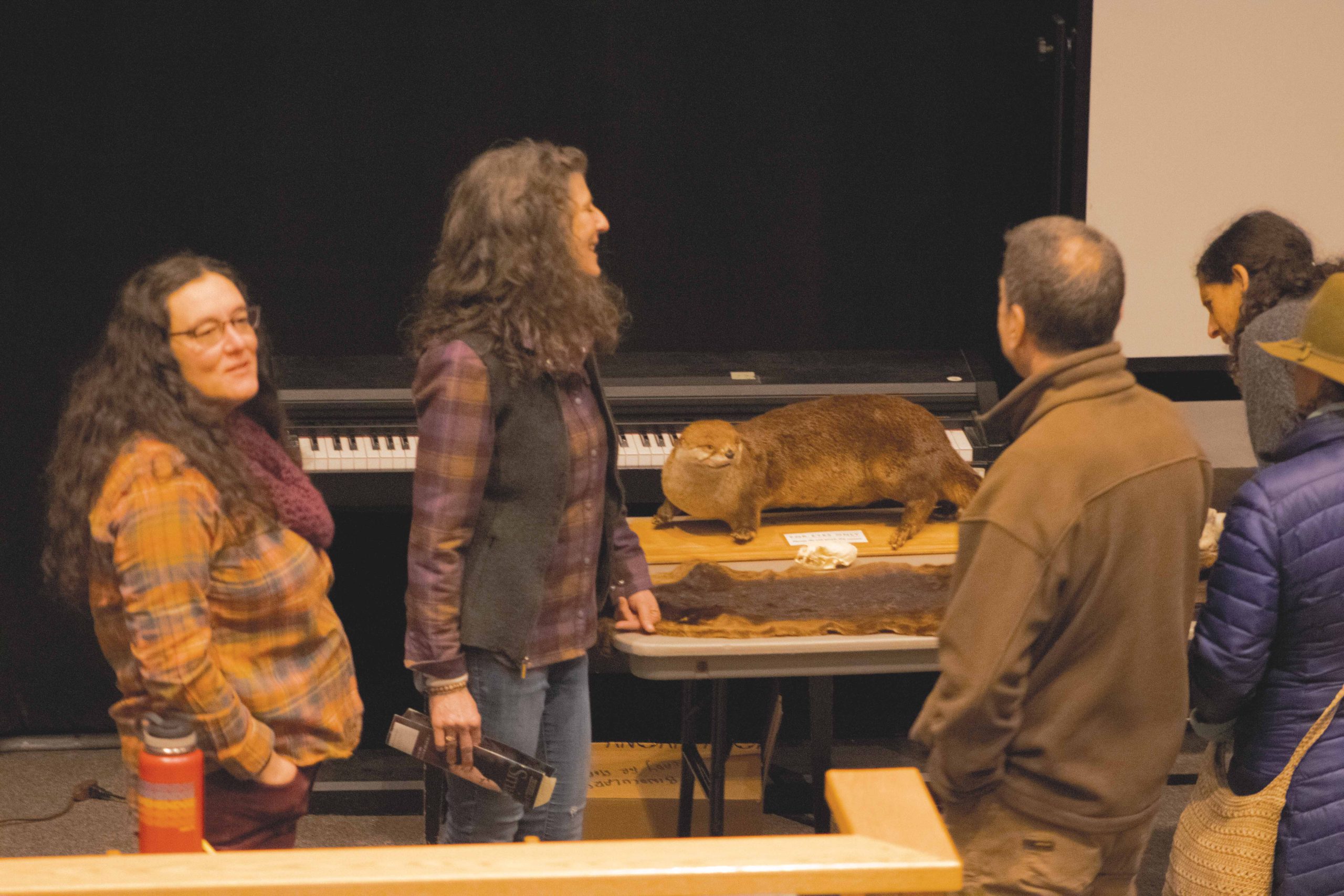
The KSC Film Society partnered with the Harris Center for Conservation Education and the Monadnock Conservancy to screen “The Mighty Weasel,” an episode of PBS’s long-running “Nature” documentary series. The nearly hour-long episode explored the hidden world of the Mustelidae family. The film included Honey Badgers, an orphaned weasel being raised in captivity, and a family of weasels fighting to survive and thrive.
The screening was held on Thursday, December 5 at the Redfern Arts Center’s Putnam Theater. Senior and President of the KSC Film Society Ryan Severn said the screening was part of the organization’s longer tradition of screening nature documentaries.
“We’ve done these kinds of collaborations in the past, but that’s slowed down since the pandemic,” said Severn.
“We’ve been trying to bring this kind of thing back, where we show a nature film and have things on display, and it’s a great way to combine film and good causes together. I hope people learned something tonight,” added Severn.
The screening highlighted the importance of unlearning stigmas against animal species, such as how weasels are viewed as “bloodthirsty.” Naturalist and nature educator Susie Spikol answered audience questions and spoke about the various species of weasels in New Hampshire at the end of the screening.
“We have this tendency to apply animal names to undesirable human behaviors, such as “weaseling out of things” or “badgering someone” and that impacts the way we perceive the actual creatures,” said Spikol.
“Weasels get a bad reputation because farmers check their chicken coops and find that a weasel has killed their chickens. What people don’t understand is the weasel will go after chickens as a last resort when other food sources have depleted, and that same weasel was likely an unsung form of pest control up until that moment,” added Spikol.
“The same goes for fisher cats, which aren’t actually cats. People lose their pets, and assume a fisher cat ate them, when the number one threat to domestic pets is actually the automobile,” added Spikol.
Spikol expressed concerns that negative perceptions of species have the potential to hinder enthusiasm surrounding conservation efforts.
“We like to go all out for cute and cuddly animals that have good reputations and don’t scare us. People don’t want to put the same energy into other animals like the weasel because of that bad reputation, which is unfortunate because once any species is gone, it’s gone for good,” said Spikol.
According to Spikol, some species of weasels are also threatened by climate change.
“The short-tailed weasel and the long-tailed weasel undergo fur changes in the winter, and turn white to blend in with the snow. This happens regardless of how much snow the area gets, and decreasing snowfall means these animal’s natural camouflage ends up backfiring and causing them to be targets for larger predators,” said Spikol.
Brett Thelen, who serves as science director for the Harris Center, accompanied Spikol to the event.
Thelen expressed gratitude for the chance to work with the Film Society and the Monadnock Conservancy and said he hopes the screening gave audiences a chance to rethink their perceptions of weasels.
“The more we can understand some of these maligned animals, the better it is for them and us,” said Thelen.
“That’s how we develop a sense of compassion and kinship with our wild neighbors,” added Thelen.
Community member Richard Pendleton attended the screening as a nature enthusiast.
“I love the outdoors and learning about wildlife and habitats,” said Pendleton.
“I didn’t realize how many species of weasels we have around here, and I never knew how tiny they can be. I’m certainly going to be looking at stone walls more carefully to see if I can find them,” added Pendleton.
Ryan Pacheco can be contacted at
rpacheco@kscequinox.com