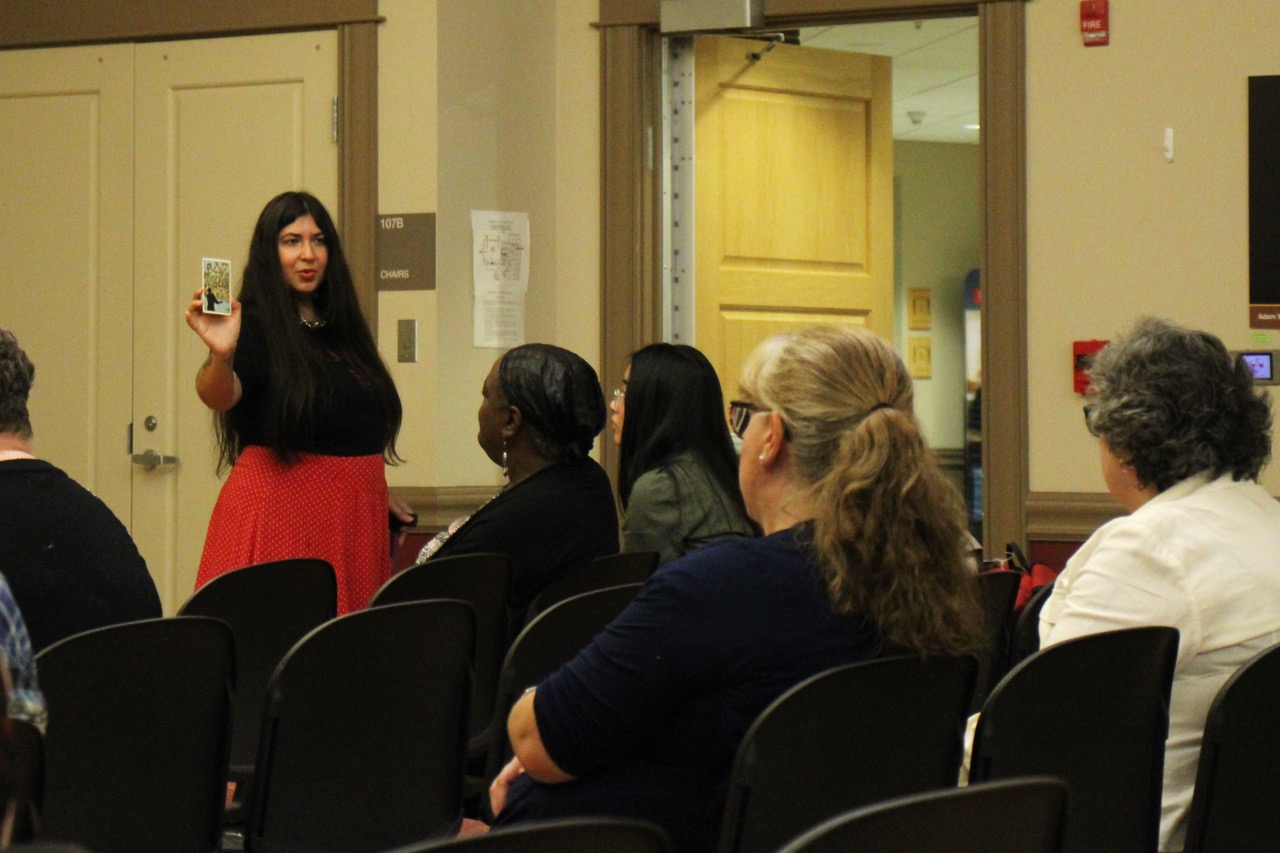
Keene residents and KSC students heard about Romani history and their own futures at Jezmina Von Thiele’s talk at Norma Walker Hall.
The event took place October 23 and was organized by Dottie Morris, associate vice president for institutional equity and diversity.
“I met [Von Thiele] at an event and we were just talking … and I thought, ‘Wow, that’s so interesting, I would like to have you come to campus,’” said Morris. “I would like for people to know that there are other ways of knowing. And most of all to clear up some of the myths and misconceptions about Roma culture.”
Von Thiele primarily focused the talk on fortune telling, tarot card readings in particular, but she also spoke about Romani culture and history. The Romani people are a diasporic ethnic group who came to Europe from India in the late 1300s. They were enslaved for several hundred years in what is now Romania and were often persecuted in other European countries as well.
“Lots of anti-Romani laws, some of them encouraging the hunting of Romani people, some of them forbidding Romani people to settle or forbidding Romani people to travel,” stated Von Thiele during her talk. “Over the centuries, Romani people have developed ingenious trades to make a living in the margins.”
Some examples of traditional Romani trades Von Thiele gave were performing, horse trading, basket weaving and fortune telling.
Von Thiele stated that her family were traditionally fortune tellers, and she still practices that art. She spoke on how she was taught to meditate and read fortunes from playing cards from a young age as she was seen to have good intuition.
“My maternal grandmother is Roma and she raised me with her family fortune-telling survival trade,” said Von Thiele. “And I started learning from the age of four. And I was allowed to pursue other work or education if I wanted to, but I always did this work and it became a big part of my activism and also an aid to my creative process.”
After the discussion of Romani history, Von Thiele spoke about what is known as the “clair-senses”: different psychic abilities that some people believe that they possess. She opened up discussion to the audience, allowing them to talk about experiences they have had that they could not explain or believed were due to psychic abilities.
“I really appreciated how participatory people were,” said Morris. “They were listening and taking part … Even if it didn’t quite fit for them, it seemed like people did get something out of it.”
To conclude the talk, Von Thiele led attendees in a meditation exercise meant to clear one’s mind and focus their intuition. She also did a quick tarot reading for the audience and asked attendees to give their own interpretation of the cards, then answered any remaining questions that attendees had for her about Romani culture and history or fortune telling.
Although attendees had differing beliefs about fortune-telling and psychic abilities, many found it interesting and educational.
“I thought the spiritual aspect of it was very interesting,” said senior Jonathan Smyers. “I’m not really exposed to that in life … so being here, getting a different perspective, is pretty cool.”
“I did one of the readings before [the talk] and it felt pretty accurate to my life right now,” continued Smyers. “Which is kind of scary.”
Von Thiele reads fortunes professionally here in New Hampshire and is also the co-author of a book titled “Secrets of Romani Fortune Telling: Divining With Tarot, Palmistry, Tea Leaves, and More” and the co-host of the Romanistan podcast.
“Romanistan podcast is a celebration of Romani culture and people,” said Von Thiele. “We like to interview Roma from different walks of life…we really especially love uplifting LGBTQ folks, multi-racial Roma, Roma from all different types of backgrounds and professions.”
“We chose the name Romanistan because it is the name for our home country,” continued Von Thiele. “We don’t have a home country, but the idea is that Romanistan is anywhere Roma are.”
Orion Corbin can be contacted at