
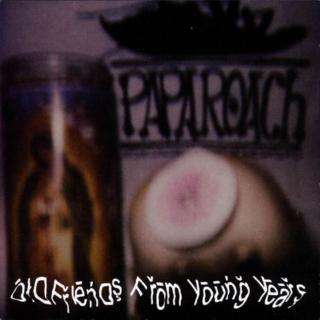
In 1997, when punk was still alive, future radio-rap-rockers Papa Roach flexed their muscles for the first time.
Though they introduced themselves to a worldwide audience in 2001 with the stomping, raging Gen X anthem of angst “Last Resort,” the Roach began as a scrappy eclectic local band playing college shows in 1990s California. “Old Friends for Young Years,” their oft-forgotten indie debut, embodies the frenzied energy of ‘90s nu metal, similar to what can be heard from contemporaries such as debut-era Limp Bizkit or even the tragically short-lived tenure of the original Snot.
“Old Friends,” however, redefines frenzy with seemingly nonsensical lyrics that at times resemble childlike babble and a tone that remains impossible to pin down as either manic or depressive.
“Orange Drive Palms,” the first track after the intro, is probably my favorite Roach song to date. Frontman Jacoby Shaddix wails like an alley cat over a riff reminiscent of Deftones on “Adrenaline.” The album’s scatological fascination begins right away, with Shaddix complaining in the chorus, “Someone’s sphincter is in my eye.”
In contrast, “Liquid Diet” features one of the few glimpses of coherence through the haze, as well as featuring some actually identifiable rapping as the band would continue to integrate into their sound on future releases. Shaddix lashes out against domestic abuse and urges a female victim character to escape the situation in an apparent well-meaning if somewhat reductive, message.
Towards the latter part of the album, “PEEWAGON,” stylized as such, is another favorite of mine. It has the same thrashing anxiety of “Liquid Diet” but is more dynamically similar to “Orange Drive Palms” with how it jumps up and down from droning, almost crooning monotone sung verses to screeching choruses.
As the title suggests, “PEEWAGON” is perhaps the most flagrant example of the album’s relation to excrement, genitalia and all things that disgust the average person. Somewhere in there is a real neurosis around being a child who cannot control basic bodily functions. Shaddix channels a child’s first experience of shame with the repeated plea, “Mommy, I don’t want to go to Billy’s!”
Apart from highlights like these, the album overall is relatively sparse; there is not a lot of meat here. Tracks like “hedake” are minimal on the lyrics, focusing on a hypnotic loop of trading riffs and muffled vocals, while others like “iSEDuF**nDie” opt for a hip hop-oriented take with guitar only coming in on the choruses. “Living Room” even offers a laid-back instrumental interlude as a break from the rage and grief of the rest of the record.
This lack of balance does take away from the album, turning it into a rocky ride through the band’s ideas of what they wanted to be. Some of those ideas were better than others, and although I find it interesting to retrace the steps of a group of young creatives, I also think it is disappointing to reflect on some of the misused potential shown on this album.
“Old Friends” was produced by the father of bassist Tobin Esperance and released on the band’s independent label, and it is not hard to tell. The stink of basement production pairs well with the challenging and grotesque subject matter, and the DIY integrity of this early iteration of the band is something I think deserves recognition, regardless of where they would go after signing to a major label.
It would be an exaggeration to say the album is avant-garde in any way, as the level of intentionality on display is almost certainly not to a level where I could say so with a straight face. Even so, the strong use of themes and general disregard for song structure put “Old Friends” in a space where there truly are no rules and youthful hunger rules all. Despite the album’s sparsity, the chunks of meat are well worth chewing the bones for.
Although “Infest” (2001) and subsequent releases have largely tread over the legacy of “Old Friends from Young Years,” I would prefer to have this version of Papa Roach be the one I remember. A perfect world would have seen Roach continue down the path they walked here in 1997.
Charlotte King can be contacted at
cking@kscequinox.com