
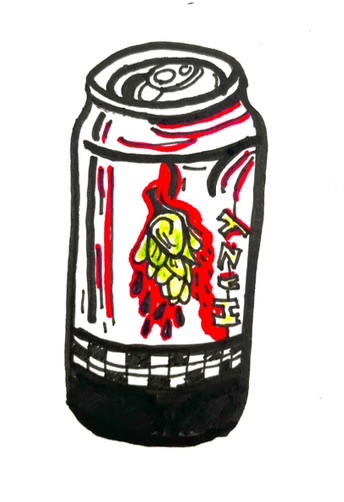
The artwork presented on beer cans was recently scrutinized by Dover Youth 2 Youth members, in support of a bill that would prohibit certain imagery from appearing on the labels.
While I can appreciate the intentions of the group, I think the anger is misplaced. For the longest time, small and independent craft breweries have used graphics and artwork on their labels in an effort to differentiate themselves from large beer companies. While one should not judge a book by its cover, or a beer by its label, it is undeniable that marketing and labeling of products affect consumer choice.
The beer can that sparked the particular debate in the N.H. State House was Concord Craft Brewing Co.’s “Finding NEIPA,” which depicted a blue tang fish, and clownfish akin to Dory and Nemo from Disney’s “Finding Nemo.”
According to a Feb. 7 NHPR article from Todd Bookman, the issue the group had with the can was a concern the label was, either intentionally or not, appealing to minors.
Current N.H. law already states the state Liquor Commission can block any labels they deem to be appealing to minors in design. SB 335, the bill Dover Youth 2 Youth spoke in support of, would further limit design by explicitly stating toys, robots, fictional animals and creatures consistent with other products marketed toward minors on labels, according to the article.
Targeting artwork on beer labels, which are disproportionately displayed on small breweries’ cans, seems like a move missing the mark by quite a bit.
In 2022, craft beer accounted for nearly a quarter of the total U.S. retail beer market, according to data published by Jan Conway of Statista.
Despite market share increasing in recent years due to the craft beer boom, these small breweries are still fighting for every sliver against industry giants who have been in the business for a lot longer.
Craft breweries do not have the immense resources and marketing tools that bigger companies have at their disposal, so instead they have opted to make the cans themselves appealing.
If you take a walk in any alcohol aisle of a grocery store here in N.H., you will see the stark difference between big brands and craft cans. The artwork, as well as the naming conventions of craft beers, have become a symbol of “The little guy,” in the industry.
Beer and liquor in general is already regulated quite a bit. For starters, you need to be 21 or older to buy or consume it in the first place. This, in and of itself, is a barrier preventing minors from at least outright buying alcohol in a store.
I would take this a step further, and say for the stores which do not ID people (because we all know they are out there), minors are not going to opt to purchase beer that costs $20 for a four-pack. If anything, minors would be drawn toward the more low-cost, high-alcohol-content beers.
“But what if there are craft beer cans in a kid’s parents’ fridge?”, you may ask. Well, I would leave this issue up to the parents themselves. You should not leave beer cans in clear-shot of a child’s view. There are easy ways to prevent something like this from happening, but again, I do not believe this issue is isolated to only beers with cartoonish labels.
You can tell apart beer cans from something like soda almost right away, as craft beer cans almost always have an exposed aluminum rim at the top and bottom, with the label only covering the body of the can.
If there is any alcohol-related issue I think should be tackled, it is the rising prevalence of coffee and energy drink brands stepping into the market.
With caffeine reliance already being an issue for minors, this is only made worse when combined with an alcohol element. The branding for the products looks just like the energy drinks themselves, with an added adjective of “spiked,” to denote alcohol content. I would support legislation in a heartbeat that regulated something like this, as opposed to SB 335, which is a solution in search of a problem.
Nathan Hope can be contacted at
nhope@kscequinox.com