
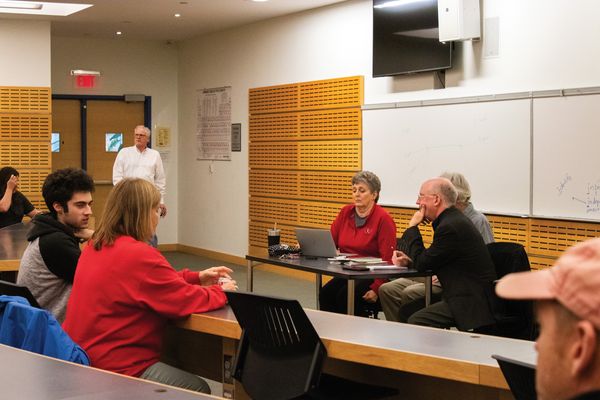
An open forum to analyze and suggest revisions to Keene State’s general education program was held on Friday, Oct. 20 in the David F. Putnam Science Center. Attendees were able to voice their thoughts on the current state of the general education program.
The forum was held by General Education Reform Task Force co-chairs Keene State journalism Assistant Professor Kim Lauffer, history Professor Gregory Knouff and mathematics Professor Mike Cullinane.
During the forum, Knouff said the revision is still in its “feedback stage” and over the fall semester they have been gathering this feedback primarily from students. They hope to have interpreted the trends and produce a rough draft model to present early in the 2024 spring semester. More feedback and suggestions will be taken into account upon release of the draft, and a finalized version will be sent to the KSC Senate for adjudication.
The forum opened with the council asking about the current strengths of the ISP program.
Joe Darby, a music professor at Keene State, said the ISP program has two main strengths: The selection of choices and how students are “excited” about the courses available.
Following Darby’s comment, the conversation switched away from the strengths, moving into the weaknesses and suggestions for the program. Sarah McGregor, an associate professor of physics at Keene State, said in order to properly assess a program’s strengths and weaknesses there needs to be a clearly defined goal and purpose of said program. She said the actual understanding of general education remains gray for a lot of students.
“[Having a goal] helps to define how it’s going to be evolved or reformed, basing it on whether or not that you’re meeting that goal or purpose. So, I throw that back to you guys,” McGregor said.
Knouff responded with his ideal of what the general education program’s goal should be: a way to develop skills and form a sturdy base for all Keene State students.
“The primary role of the ISP [program] is to form the core of every student who goes to Keene State,” Knouff said. “What their general education experience would be in terms of breadth of knowledge, in terms of skill development.”
Junior Jacob Favolise, who serves as a KSC Senator, re-emphasized to the council that a weakness of the program is student understanding beyond just “checking boxes.” He said that students should be able to take classes because they are interested, and the ISP program should help them explore classes, especially upper-levels classes, organically.
He said it was “hard to get behind” the current system of taking higher-level ISPs, which often puts students in the difficult position of needing to employ skills they have no experience with, again stressing the importance for students to have relevant classes they want to take.
“I do have a problem with students being forced to take courses repeatedly in the ISP program that is just what fits in their table. I don’t think that is appropriate,” Favolise said. “Students are paying for each of their courses… I think it’s more likely that students feel like ‘I’m spending a lot of money to take this class, I don’t understand the purpose of why I’m taking it, I did really want to take it, so I sort of just put it in my schedule.’”
After multiple attendees mentioned potential expansion of the programs, Cullinane said one of the biggest constraints limiting implementation and reworking of individual courses falls down to budget. The committee has to provide their plan with no extra cost added to the existing budget. Funding has only gone down for the ISP program since 2007, he said. On top of funding constraints, Cullinane said a lot of professors do not or have not wanted to teach general education courses in the past; they want to teach their major.
Jesse Marcum, an associate chemistry professor at Keene State, said ISP enrollment can often turn into a “turf war” between majors. General education courses subsidize department enrollments which can lead to “adversarial” relationships between departments. Rather than “pretend that isn’t the case,” Marcum said that in addition to being aware, there should be more equitable opportunities for the departments to seek enrollment without creating a hostile environment.
Toward the end of the forum, Marcum said the ISP program cannot currently be “divorced” from “window dressing.” ISPs are largely influenced by public perception and appearance, the optics of the program. The disconnect between the public and what ISPs should accomplish is changing.
Cullinane said he agreed with Marcum’s observation but had “to be careful about chasing trends.” The public’s view can rapidly change, and it is for this reason the ISP’s need to remain “grounded in the mission of the college” while “serving students,” Cullinane said.
Harvie Marcotti can be contacted at
hmarcotti@kscequinox.com