

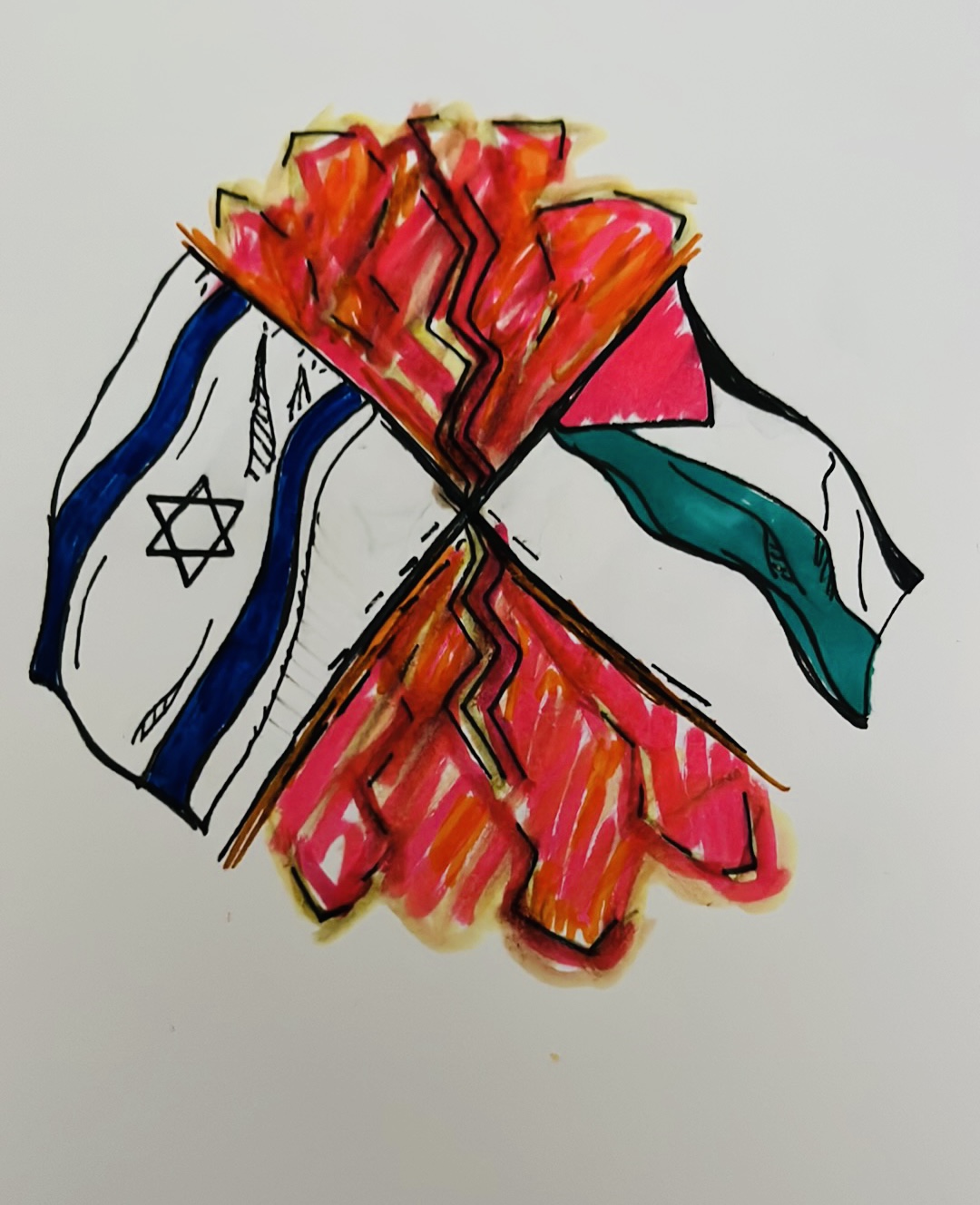
Following a reignition of tensions between Israel and the military organization Hamas, the Holocaust and Genocide Studies (HGS) and Cohen Center hosted a public informal conversation centered around the conflict.
On Oct. 7, Hamas fighters launched an invasion in Israel, leaving at least 100 civilians dead and many kidnapped, while retaliatory airstrikes from Israel killed nearly 200 Palestinians, according to an Oct. 7 article from Vox. Following the onset of the Hamas invasion, Israel has since declared war, according to an Oct. 8 article from CNN.
An Oct. 9 email sent by KSC President Melinda Treadwell expressed “profound sadness” regarding the conflict, detailing hundreds of deaths that had occurred. “It is indiscriminate violence on a jarring and unprecedented level for this part of the world…” Treadwell stated. The email concluded with an announcement that there would be an informal conversation held about the conflict on Oct. 13 from 12 p.m. to 1 p.m. at Norma Walker Hall in the Alumni Center.
The event was facilitated by Kate DeConinck, who serves as director of the Cohen Center, and included a panel of KSC faculty and staff. The panel included Ashley Greene and Dana Smith (HGS faculty), Phil Barker (politics faculty), Jason Beaubien (journalism faculty) and Celia Rabinowitz, who serves as director of the Mason Library.
Each panel member gave an opening statement, followed by a brief question-and-answer period where audience members could either ask the panel about the conflict or voice their thoughts.
DeConinck opened the event with introductory remarks explaining that the event was partly inspired by HGS faculty having received emails from scared and concerned students regarding the conflict. DeConinck noted that the event’s purpose was to be a “first step in processing the events of the past week” and that it was not an all-encompassing forum regarding the war.
Smith, who also serves as chair of the HGS department, noted her concerns about the rise in anti-Semitic violence seen globally following the beginning of the conflict, specifically referencing an anti-Semitic rally held in Sydney, Australia.
Greene explained how guerilla warfare tactics deployed by Hamas and the use of civilian populations to shield militants invite non-traditional warfare methods historically. Greene also said she hopes that safe evacuation methods will be offered for citizens in the region.
Barker, who teaches classes in international politics, said that while both sides work to ensure their security, if one side takes measures to advance that goal, it threatens the other. Barker explained that there aren’t any “simple or easy answers” regarding the conflict and that it is causing “good people to do awful, terrible things.”
Beaubien, who previously worked as an NPR correspondent in the middle east, urged the audience to understand the sentiment among Palestinian civilians and those of neighboring countries regarding Israel. “There’s a large part of people in that world where Palestinians have been mistreated,” Beaubien said. “Hamas is not the entire Palestinian population.”
Rabinowitz, who is Jewish and lived in Jerusalem for years, said that she feels a conflict between her identity and her political stance in regards to the conflict. “I would encourage folks not to make assumptions about Jewish people, Muslims, Palestinians, and Israelis,” Rabinowitz noted she still has family members living in Israel, and that she had to check in with them to ensure they were safe. She also explained her disagreement with the actions of Israel’s government. “The behavior of the Israeli government does not reflect what I think being Jewish is,” she remarked. “The only victory here is if there’s some kind of peace and I haven’t seen a way to get there the past few days,” she said.
After the opening remarks concluded, audience members began asking questions and making comments on the war. One audience member asked the panel why a two-state solution between Israel and Palestine had “dropped out of the picture.” Barker responded to the question by mentioning how the government of Benjamin Netanyahu had played a role in taking talks of a two-state solution off the table. Barker noted a historic lack of trust between Israel and Palestine also being a roadblock in any peace talks.
Tyler Shannon, an environmental science professor at KSC, commented on countries vying for influence in the region, specifically referencing Iran and the U.S. “The United States is committing unconditional support to Israel that, according to experts, could leave a lot more [civilians] dead,” Shannon stated.
An audience member from Brattleboro, Vt. commented on the humanitarian conditions in the Gaza Strip. “No water, utilities, or food. I’m frustrated as a human species we don’t have a plan to survive this. I feel so helpless. It’s always the citizens that suffer most.”
Isabelle Handy, a 2021 alum of KSC, voiced opposition to unconditional aid to Israel from the U.S. “Are there any ways to pull back support for peacebuilding?” Handy asked.
Rabinowitz responded to the question by saying that the U.S. does not have a great track record of mediating international conflicts. Greene agreed, adding that U.S. politicians’ lack of comfort with ambiguous situations makes things difficult as well.
DeConinck concluded the event by thanking audience members for attending, saying that she is willing to host more events or discussions to help community members navigate the topic.
Nathan Hope can be contacted at
nhope@kscequinox.com