

With KSC Student Government elections having come and gone this year, students may not know who their representatives are, what they do and the organization’s role on campus.
Vice President for Student Engagement Jen Ferrell, who serves as an advisor to KSC Student Government, said there are many reasons why students choose to run and serve. “Some folks have a real, true interest in politics and what that looks like… Some folks like the event-planning elements of it… There is a PR committee so if there are folks who are really interested in growing their resume around public relations they may have an interest,” Ferrell explained.
“For some students, I think, it really is just an interest in getting to have a little bit of a say in what happens on campus… I think they put themselves out there to be able to share their thoughts and opinions and that kind of thing,” she said. “I think if you asked all of the [KSC Student Government] members, they would all give you some slightly different response as to why they ran.”
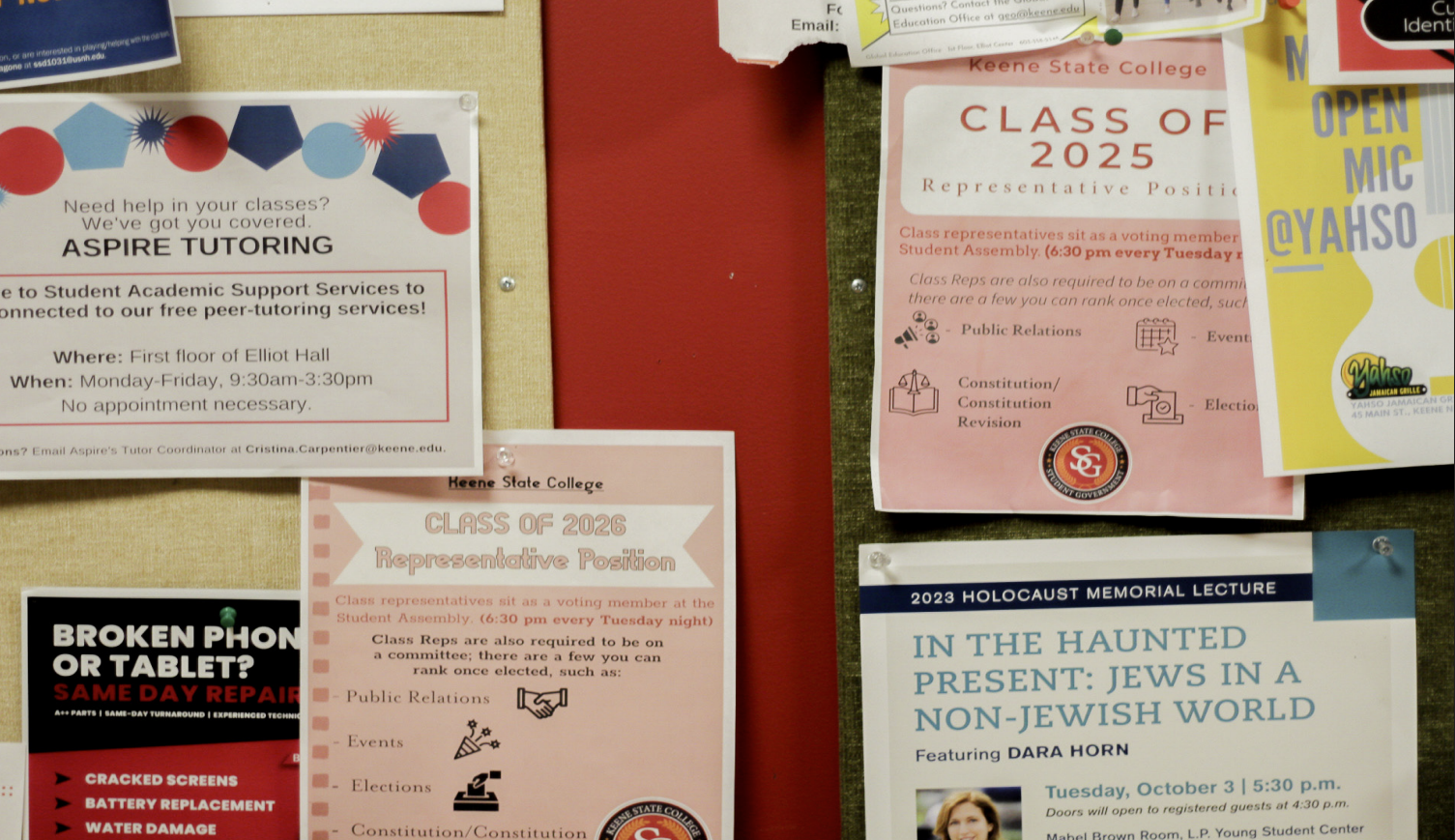
In terms of positions in student government, there are several: Class President, Class Vice President, Treasurer, Secretary and Class Representatives. Additionally, there are positions for Student Body President, Student Body Vice President, University System Student Board Representatives (USSBRs) and a Non-Traditional Student Representative. Class positions within student government are elected solely by members of the candidate’s class, while student body positions are elected by the entirety of the student body. Traditionally, there are four class representatives per class, Ferrell explained.
USSBRs attend meetings for the University System of New Hampshire (USNH) Board of Trustees and work with the Board of Trustees on specific student concerns, according to Ferrell. “Last year, they [USSBRs] worked through some conversations on collecting data from all the institutions around mental health, and did a presentation for the board at the board meeting,” she explained.
In addition, there is a rotating position of Student Trustee, a student at a college who has a vote on the USNH Board of Trustees. Previously, Dominic Lynch, who since graduated, served in the position. The position of Student Trustee has now rotated out to Plymouth State University and the University of New Hampshire, Ferrell noted.
Additionally, there is a speaker who facilitates student government meetings, a treasurer who serves on the Finance Committee and a secretary who brings together class secretaries to work on the constitution committee, Ferrell said. All of these positions are elected by student government members themselves.
Student Body Vice President and junior Mary Ronning said she came into student government as a means of getting involved and meeting people. “I knew people in student government like Brooke [Richards], and so they had encouraged me to run because I hadn’t made a lot of those connections,” Ronning said, noting that being a commuter student was a roadblock for her at first.
In terms of what Ronning has done on student government that she’s most proud of, she mentioned student government’s Dinner and Decorating with KSC President Melinda Treadwell. Ronning said the event was a long-standing tradition before the COVID-19 pandemic, and that beginning to hold it again was important for student engagement.
Ronning’s advice to prospective student government members was to not be afraid to run. “I was very afraid to run because I was a commuter student, I felt like nobody knew who I was. As a little freshman, I had a lot of doubt, and I was very self-conscious too… but be afraid to get involved,” she said.
Ronning said she and Student Body President Brooke Richards would be willing to meet with students interested in running to explain what student government does.
Richards, a senior, recounted her experience serving on student government over the past few years. “I never had done student government in high school or anything of that sort, so they had sent out petitions and ballots… and I was like, ‘Oh that’s really interesting,’ so I ran as Class Treasurer… It was just something I really wanted to do to get involved and then I got it,” she explained.
Richards explained that the COVID-19 pandemic had a significant impact on her college experience as a first-year student in particular. “We were coming back from COVID, and the way that they did things before COVID was one way, and when we came back it all changed,” she said.
In terms of what student government does, Richards explained the organization’s role in event planning as well as other on-campus organizations. “Pumpkin Palooza, we plan and orchestrate all of that… and Spring Carnival,” she said, noting the Events Committee works on both events. Richards said that the Constitution Committee is part of the approval process when a new on-campus organization is created or an organization wants to revise its constitution.
Richards said that the student government wants to finish revising its constitution to update language and increase governance on campus, in order to bring to the forefront the policy and procedure side of things. Richards also noted that the student government has a say in the funding of organizations.
Richards said that one misconception of student government was that everyone involved is solely interested in politics. “We really are trying to make it so that there’s two halves that really make it one, so one half would be the event planning, and if you don’t want to do anything with the policy and procedure, that’s okay, we have this other side for you, but you can still get bits of the policy and procedure side,” she said.
Richards’ advice to those who want to be involved in student government is to know that if you are elected, there’s a reason you were put in that position and to go into it with an open mind. “Be a voice for students,” she said.
Nathan Hope can be contacted at
nhope@kscequinox.com