

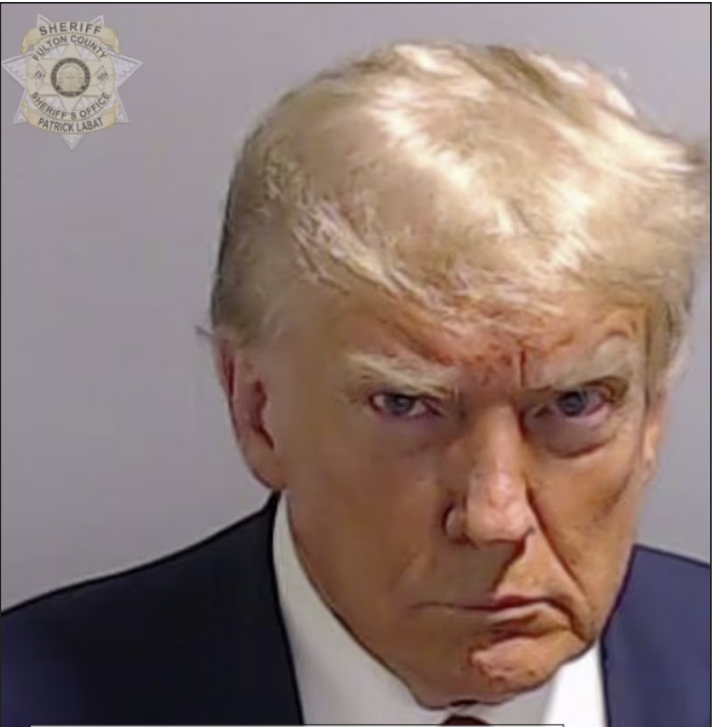
On Aug. 24, the Fulton County Sheriff’s office in Atlanta, Georgia released the mugshot of Donald Trump, marking the first ever mugshot of a former U.S. president. While it is tempting to make fun of his admittedly goofy mugshot, it will only serve to rile up his base of supporters and prolong Trump’s spotlight in the media for all the wrong reasons.
According to Megan Lebowitz from NBC News, Donald Trump is facing 13 charges in Fulton County relating to a plot in which he is alleged to have attempted an illegal and forceful overturn of the 2020 presidential election.
The charges by Fulton county mark the fourth indictment facing Donald Trump. According to Zach Schonfeld from The Hill, Fulton County deliberately ignored the no-mugshot precedent set by the other three courts, which argued there was more than enough publicly available imagery of Trump, or simply submitted one of those publicly available images.
Mugshots were initially conceived in the 19th century as a way for police to keep a visual record of those facing criminal accusations. If one were to try and flee their court date or escape prison, then a mugshot has practical use to help identify and locate the individual. If a previous offender is detained later on different charges, then a mugshot would be useful for police to identify that the individual had been booked in the past.
The entire country already had their eyes on Trump, who also happens to have one of, if not the most, recognizable faces in the world. The justification for a mugshot simply does not exist beyond tradition and the results have greatly humorized Trump’s current image.
Upon its release, the internet was immediately enthralled with not only the fact that there was a mugshot of Donald Trump, but how he chose to characterize himself. He stares into the camera with an angry grimace, disgust radiating from his glare, his iconic blond hair on full display. He is not giving up, but instead is ready to fight.
The same night that the Trump mugshot became public, his campaign team began making merchandise to capitalize on the publicity to come. This should come as no surprise, perhaps even expected. After the previous indictments in which no mugshots were taken, the Trump team quickly worked to release shirts featuring fake mugshots of Trump. The capital to gain from such merchandise has been a clear goal of his team.
Following the release of the real mugshot, an influx of merchandise began being released by every corner of the internet, from individuals on Etsy to Green Day. Pro-Trump merch uses the mugshot as a way to frame his charges as being politically motivated, while anti-Trump merch focuses on his silly and memeable expression.
While one might view popular figures and groups such as Green Day expressing their dislike of Trump as a way to harm his reputation, this is unquestionably wrong. They are simply affirming their dislike amongst one another while reducing how serious of a threat they view Trump as. No Trump supporter’s mind is going to be changed because Green Day released a shirt calling Trump a “nimrod”, a reference to their 1997 album under the same name.
The mugshot provided huge financial success for all those involved. On Aug. 26, not even three days after its publicization, Trump Campaign Spokesman Steven Cheung released a statement on X (formerly Twitter) reporting $7.1 million in gross profit from the Mugshot Merchandise.
Aug. 25 marked the highest grossing day throughout the entirety of the Trump campaign at $4.18 million. Purchases from stores operated by political campaigns are able to be counted as donations, meaning all the money made by the Trump Campaign can be used to further his bid for the 2024 presidency. With little money to spend outside of legal fees, this is a clear success for Trump, a direct result of Fulton County Sheriff’s Department’s ignorance.
Organizations with an anti-Trump message try to justify their contribution to the pool of merchandise through how the money would be used.
The Lincoln Project is one such organization that stated all profits from the selling of mugshot merch would be used to raise awareness about Trump’s “threat to the Republic,” cofounder Rich Wilson told the New York Times. Even if the Lincoln Project could be undoubtedly trusted about where their money goes, it is simply an ineffective strategy. Everyone knows who Donald Trump is, just admit you want money.
Since his 2016 presidential campaign, Trump has operated under the slogan ‘all publicity is good publicity’, and in his case, he is 100% correct. Hugo Lowell of The Guardian compared polling numbers collected by Coefficient and Morning Consult Poll from the beginning of August to those from after the release of the mugshot. In addition to a three point increase in overall popularity, “the share of voters who believed Trump is guilty of the charges dropped by 11%,” writes Lowell. No attempt at negative media coverage has resulted in masses of people abandoning their support for Trump. Controversy after controversy, indictment after indictment, his base remains strong and loyal. The memes and merchandise about Trump, no matter how negative, only proves to keep his name in the news and his face everywhere, furthering his popularity.
A mugshot is shameful; “normally you would be ashamed of a mugshot and what it represents… but this is a way for both sides to own it… and make it safe by turning it into a commodity,” according to a statement that Wendy A. Woloson, a professor of history at Rutgers University-Camden, gave to the New York Times.
Donald Trump is a threat, and no matter how silly, a threat is a threat. While it can be fun to participate in ‘dunking’ on Trump, it only furthers the desensitization of his actions to the public while keeping all attention on himself. Afterall it is no accident that he turned himself in the day after the first Republican Primary Debates, which he did not attend. Contributing to the cycle of monetization is not helping fight against Trump, it is a result of America’s rampant consumer culture. I am not suggesting that we ignore Trump, that is impossible and reductive. However, you can and should engage with the topic of Trump without glorifying him and focus on why, according to Alison Durkee from Forbes, he is facing 91 federal and state charges, with a maximum sentence of 717.5 years in prison.
Harvie Marcotti can be contacted at
Hm1212@usnh.edu