

Pictures have always been a way to capture memorable moments or express cultural norms. With the introduction of the smartphone, society has discovered an entirely new genre of cultural expression: selfies. Some argue the selfie adds to the narcissism of today’s youths while others counter it is an expression of self-love. The truth is that both of these arguments are true; but lately, selfies have become a way to prove ourselves to our peers.
Posting pictures to social media has always been a way to show our virtual friends that we live a desirable, but often unrealistic lifestyle. We passive-aggressively try to show everyone that we have these beautiful, fun and confident lives. We do this so our colleagues will hopefully see us as better than others so we feel wanted by the rest of society. Nowadays, the best way to do this is through posting selfies.
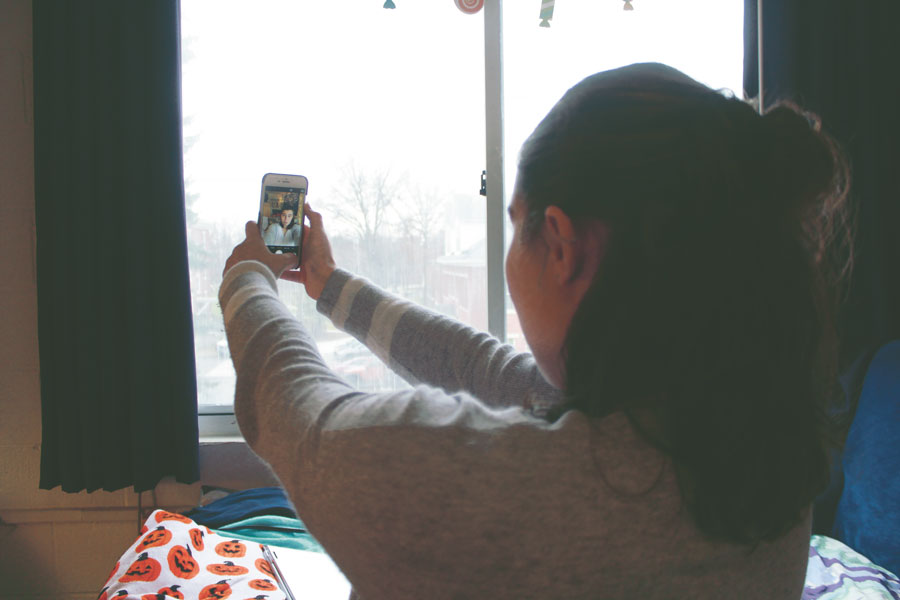
Luke Stergiou / Equinox staff
By posting selfies, we give off a sense of self-confidence. When posting a picture of ourselves looking all fun and cute, we tell viewers “Hey world, this is me. I look good today and I feel like that needs to be shared.”
From that post, often times viewers will “like” it and, today, the more likes you get the cooler you’re considered to be and the better about yourself you feel.
There is nothing wrong with seeking approval from others. Approval leads to a healthier sense of self along with a healthier psychological well being. But the constant posting of selfies for the approval of others can be a dangerous path that leads to digital narcissism.
Professor of Business Psychology at University College London Tomas Chamorro-Premuzic stated, “When taken too far the desire to be accepted morphs into a relentless quest for status, which undermines other people and impairs our ability to build and maintain happy relationships and successful careers.”
In other words, our need for those “likes” to feel accepted by society clouds our perception of what should be our everyday goals. Society has reached a point where we spend more time editing pictures to make sure we look desirable than we do doing homework or work for jobs.
Many try to defend excessive selfie posting as a form of self-expression and self-love which may very well be true for some. Nothing about loving yourself is bad or wrong. In fact, more people should probably learn how to love themselves. But the excessive need to be accepted has turned this self-love into a pathological problem.
The biggest issue here is that we have learned to love a version of ourselves that isn’t entirely true. We fall in love with the idea of what people think we are on social media which often causes us to lose our true sense of self.
Instead of acknowledging this, we continue to post selfies and convince others that we are 100 percent confident in ourselves because our lives are great and perfect. The obsession we have with taking and posting selfies has detached us from having a healthy sense of identity and forced us to become addicted to caring too much about how we are seen by others.
Claire Hickey can be contacted at chickey@kscequinox.com



EdwardDen
Берите Займы на Tinkoff
[url=https://zaimy-na-kartu-tinkoff.ru/]https://zaimy-na-kartu-tinkoff.ru/[/url]
CharlesSpoof
Берите Микрозаймы онлайн на Tinkof
[url=https://mikrozaimy-na-tinkoff.ru/]https://mikrozaimy-na-tinkoff.ru/[/url]
CharlesSpoof
Микрозаймы онлайн на карту
[url=https://minizajmy-online.ru/]https://minizajmy-online.ru/[/url]
DavidKet
Онлайн Займы на карту
[url=https://mikrozaimy-na-kartu.ru/]https://mikrozaimy-na-kartu.ru/[/url]
RobertGanny
Микрозаймы на карту
[url=https://mikrozajmy-na-kartu.ru/]https://mikrozajmy-na-kartu.ru/[/url]