

A recent viral video showing police brutality has sparked a nationwide conversation regarding the root problem of the issue. Students everywhere, even at Keene State College, have begun to question if they can rely on local law enforcement or fear them.
While some insist these violent acts are due to racism, it seems to me that the problem lies in police training.
The video, which takes place in a South Carolina high school classroom, depicted an African American teenage girl being yanked and thrown from her desk by officer Ben Fields, one of the school’s “resource officers.”
South Carolina’s Richland County Sheriff Department stated Fields was summoned and asked to arrest the girl after she had disturbed the class. In the video, Fields is shown telling the girl to get up “or I’ll make you.”
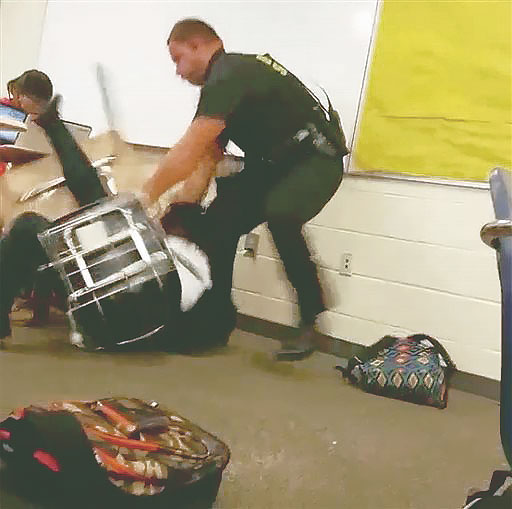
AP Photo / Student
After she refused, the two engaged in a quarrel. Fields yanked the girl’s wrist, put his arm around her neck and flipped her and her desk to the ground while the girl punched his neck. Fields then dragged the girl from the overturned desk and told her to put her hands behind her back. Following the girl’s refusal, Fields forcibly put her hands behind her back.
There are many obvious issues that are present in this situation. Was the amount of force used against the girl necessary?
Did she say something to provoke Fields? Regardless if Fields’s actions were justified or not, the situation could have been handled without violence. What’s peculiar is how no one in the classroom, not even the teacher, stepped in and helped the girl while she was being attacked. Instead, almost all of the students seemed to be looking down or away from what was happening. Is it because the girl deserved to be violently assaulted? Or maybe it’s because society has reached a place where we are too afraid to step in and help because we have come to fear the unpredictable actions of authority figures.
This incident of police brutality is just one out of a long and growing list of violent acts. An example from recent years is the case of Eric Garner, who died after being put in a choke hold and slammed to the ground. Much like the case with the high school girl from South Carolina, the reasoning behind Garner’s arrest and assault remains unclear. Many argue that the reason behind police brutality is racism. But, contrary to popular belief, the media has depicted officers of all races using overly-violent arrest methods on people of their own race. What this says about today’s officers is that, although some attacks may stem from race, maybe the problem lies in officer training. Unless you are a police officer, it’s hard to say what goes on when being taught how to properly apprehend a suspect – especially because how they are trained probably has a lot to do with where they will be working.
Though it is doubtful that officers are told to use excessive force when it is not needed, more and more officers are found doing so and their reasoning for doing so remains unclear. Perhaps these officers are assuming the worst will come from every confrontation they encounter and therefore automatically respond with extremes.
According to an article from The Atlantic, which was written by a former police officer, while in training, officers are shown brutal videos of officers being attacked. The former officer wrote that the purpose of this was not only to give officers an idea of a worst-case scenario but also to make them think of how they might have handled the situations differently. But instead, he stated, it causes officers to think with their belt and not their brains. In a situation similar to the one in South Carolina, a white officer was called to break up a fight between a group of African American teens.
However, in this case, instead of using brutality the officer defused the situation by partaking in a dance-off with the teens. As a result, the fight was broken up and both the officer and the teens left with smiles on their faces.
Was this officer trained to address conflict through the power of dance? It’s safe to say no, probably not. But what this officer knows that more that there are alternative ways to deal with tense situations other than violence. Proper police training may not be the be-all-end-all to police brutality – but it certainly may be a step in the right direction.
Claire Hickey can be contacted at chickey@kscequinox.com