
Imagine coming from a working class background, living with a chronic illness in a rural area without health insurance and the closest hospital is almost two hours away by car. For the people of Kilmarnock, Virginia and its surrounding counties, this description is too often a reality.
Thankfully, the Northern Neck Free Health Clinic [NNFHC] exists.
NNFHC is an independent community non-profit free health clinic that has served 12,500 patients since its conception in the fall of 1993. According to the clinic’s website, NNFHC serves five counties and has provided $75 million in health care in the last 20 years.
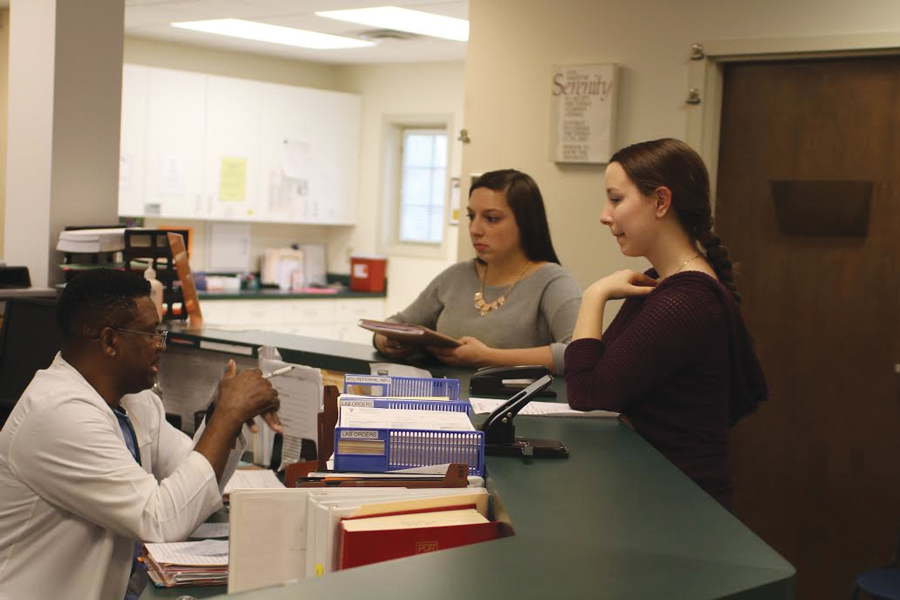
The Kilmarnock location and its outreach locations serve the area’s most vulnerable citizens, according to NNFHC’s website. These patients include those who cannot afford or are not eligible for health insurance and 70 percent of patients have at least one chronic condition. NNFHC survives on volunteer support and is funded by donations. Regular volunteer, Ida LaRhue, said she truly enjoys making a difference at NNFHC. “You can touch someone even on the telephone about picking up their medicine,” LaRhue said.
“It was exciting at first, getting to come in and learn everything and getting to talk to people,” LaRhue continued, “And then it was like, from one Monday to the next; I’m getting tired. I’m like, ‘God, is there a reason I’m doing this?’”
LaRhue was born and raised in Virginia, and after retiring from a longtime career in computer science with United Healthcare in Baltimore, Maryland, she moved back to Virginia. LaRhue has been volunteering her time every Monday in the health clinic since September 2014.
“I had this one particular patient that I had been calling for three weeks to pick his medicine up and I finally got in touch with him,” LaRhue continued, “He was telling me he was in the hospital at that time and that he couldn’t come and get his medicine and that his son was supposed to be picking up his medicines. He had just had an operation and he was like, “Pray for me.” And then he started crying and then we’re praying with each other and he was crying and I was crying.”
“This just gave me the realization that, okay, what you’re doing is worthwhile,” LaRhue concluded.
Caroline Alm / Arts & Entertainment Editor
For Dental Clinic Coordinator, Tracey Jones, her impact on her patients is what makes her job worthwhile. “The patients. I love the patients; yes ma’am,” Jones continued, “Everybody has a story.”
“They get excited when I remember their name. When they come up to the window and I go, ‘Good mornin’, sweetie!,’ and I say their name, they’ll be like, ‘Oh my Gosh, how do you remember all these names?’” Jones continued, “Yeah, that puts a smile on their face.” Jones began as a pharmacy technician volunteer at NNFHC before being hired as Dental Coordinator for the clinic in 2011.
“I volunteered in the pharmacy first as a pharmtech,” Jones continued, “And I am a pharm[acy] technician here at the Northern Neck Free Health Clinic. And then the job became available for the dental coordinator on the dental clinic side and I was asked if I wanted that job. So I started August 2, 2011 here as the dental coordinator.”
Volunteer Coordinator, Carol Gifford, also began working at NNFHC in 2011. Gifford became involved with Northern Neck Free Health Clinic in 2000 as a volunteer after moving to the area from southern New Jersey.
“One of the things that I was involved with from the very beginning was our outreach in Westmoreland County. Those people [Westmoreland County] used to always have to come down to the clinic to get screened, get their medicine, see the doctor and we brought the clinic to them. That really opened up access to care for them, especially when our patients have so many transportation issues,” Gifford continued, “Gas got to be very expensive. Some of them would just not come because they couldn’t afford to pay someone to get a ride or they couldn’t afford gas for their car. So we would bring everything to them and that was very, very helpful.” Gifford explained that medicaid has currently not been expanded in Virginia, but if it was, it would cover approximately 400,000 Virginians across the state and provide them with medical care.
“They now have to go through a free health clinic system, and the free health clinic system works well, but they [free health clinics] are dependant on grants and donations in order to survive,” Gifford reiterated. Gifford also explained that some counties have better fundraising capabilities than others due to the demographics in those areas.
“I see that there will always be a need for that kind of thing [free health clinics]. There will always be somebody who just falls outside of the boundary lines for any kind of care. We tend to guide our patients very closely through the medical system which can be very daunting to people,” Gifford concluded.
Gifford expressed that her favorite part of working at NNFHC is interacting with the people, both patients, staff and volunteers.
NNFHC’s patient population is currently comprised of 62 percent female and 38 percent male, with 50 percent of the population being Caucasian, 46 percent African American, two percent Hispanic and two percent other. The clinic provides medical, mental health, dental, specialty and pharmacy services to its patients.
For KSC Junior and health science major, Siobhan Fuller, connecting with the people of NNFHC was the most memorable part of alternative break. “I think my favorite part was the relationships that we made throughout the week,” Fuller said.
“One thing that we did was screenings. So we had to make sure that patients were eligible for service at this clinic and there were cases where patients were working multiple jobs, crazy hours a week and still fell below that percentage mark that they needed to get healthcare and it was just amazing for me,” Fuller explained.
“I felt out of place to be that person in the room that’s asking them about their financial standing, but at the same time it was kind of nice to know that they were comfortable with you in some cases,” Fuller continued, “You got to make a slight connection with them even though I have remotely no idea what it’s like to be in their shoes, but they were willing to let me take a step into them for a second and that was really cool. To be able to help them to get to where they need to be was an amazing experience.”
“Some people weren’t as open as others, and some were so open and so grateful that we were here which was also very rewarding,” Fuller described.
“They were like, “Oh, you came all the way from New Hampshire! What the heck are you doing here?” But they were very appreciative that we were taking our time to help them out and it’s nice to know,” Fuller reiterated. Jones, who recently applied to be a foster parent, expressed where she would like to see the clinic grow to in the future, “I want the clinic to be here to be able to grow to accept medicaid so that we can see the adults that do have medicaid and the children that do have medicaid, so we can be here to provide the service for them for that.”
“If I could just help one person, if somebody can remember just one thing that I tell them that will help them throughout their life, I’m satisfied. And that’s just me,” Jones emphasized.
Caroline Alm can be contacted at calm@kscequinox.com