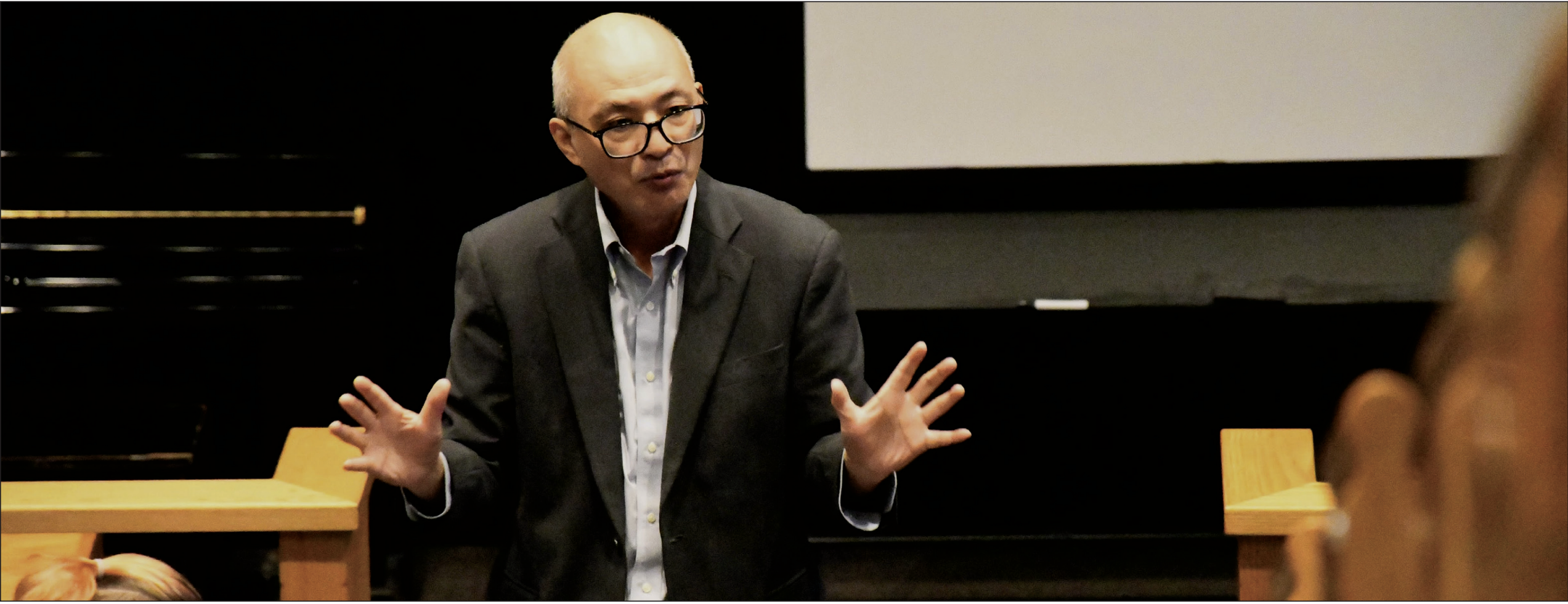
“Writing poetry was my dream. It wasn’t easy to come from a rural part of China and be in college, but I believe imagination can help you,” said poet Chen Yihai. Filmmaker Chang Changfu followed with an evening documentary about the almost half-million Chinese children adopted during China’s one-child policy who have now become cultural ambassadors to both worlds.
The duo visited Keene State College on Tuesday, Oct. 10 as part of a “Poetry Bridging Continents” program that brings Chinese artistic perspectives to campus.
Chen gave a poetry reading that took place in the Marion Woods Reading Room of the Mason Library and was followed by Chang’s film showcase at the Redfern Arts Center’s Putnam Theater.
Keyshaun Sullivan, a dual major in legal studies and English studies, attended the poetry reading, as well as the film screening.
“I came out of interest and curiosity. The meshing of Asian culture and Asian language was pretty cool,” Sullivan said. “You get this sense that all of these cultures are battling these global issues in a lot of different ways. It’s tragic, but good to see the strength that shines in contrast.”
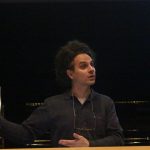
Chen is a poet, literary translator and professor at the Yancheng Teachers College in the Jiangsu province of China. Chen writes his poems in Mandarin Chinese and personally translates his work into English. Chen read selections from his work in Mandarin and was accompanied by KSC poetry students who read the same selections in English.
“I began writing poetry when I was an undergraduate. My imagination was well-trained,” Chen said.
Chen’s readings came from a variety of selections he has produced over his poetry career.
“These poems are selected from different stages of my career. Most have been written within the last few years,” Chen said. “A few of them were originally written in English, but most were written in Mandarin and translated to English.”
Additionally, Chen has translated English literature into Mandarin Chinese, including Jane Austen’s “Pride and Prejudice,” Charles Dickens’ “The Tale of Two Cities” and Daniel Defoe’s “Robinson Crusoe.”
Assistant Vice President for Academic Engagement and Director of Mason Library Celia Rabinowitz said the Mason Library sponsors the event. Other sponsors included The Monadnock Writers Group, The Class of 1939 International Education Fund, the Global Education Center and the KSC Film Department.
“A group of poets came from China in 2017. There was a fairly large event that involved poetry readings and calligraphy in the Mabel Brown Room, and we managed to travel to China a few years later,” Rabinowitz said. “Yihai and a few of the other poets spent a week with us, where we had a symposium, poetry reading, and explored the area.”
“In the last two or three decades, there have been over 400,000 Chinese children that have been adopted into loving U.S. families,” filmmaker Chang Changfu said. “When these children grow up, they bring something unique to American and Chinese societies. They become cultural ambassadors; a link to both worlds.”
Chang, a U.S.-based award-winning director, showcased “Meet Me on the Bridge,” a documentary narrating a young Asian American woman reuniting with her Chinese birth parents after they were forced to give her up for adoption due to the Chinese government’s “one-child policy.”
The documentary, which has over 600 million views on YouTube, is one of the highest-viewed videos on the BBC’s official YouTube channel. “Meet Me on the Bridge” is part of a larger series of documentaries by Chang which focus on international adoption.
Chang also screened a rough cut of his upcoming documentary “Silent War,” which explores mental health through an Asian American lens.
“The Asian American is part of the great mosaic of this country. We are witnessing a mental health crisis, and the media portrayal does not include Asian faces. People think we don’t have that issue. The 20 or 25 age group, along these lines, has two or three times the rate of depression or suicide. Asian people are two or three times less likely to seek mental health support. Cultural stigma, senses of shame and other social issues like lack of resources and funding play into the problem. I wanted to make a documentary that creates awareness,” Chang said.
Ryan Pacheco can be contacted at
rpacheco@kscequinox.com